
 Share



Traders navigated macro headlines, geopolitical friction, and bizarre corporate rumors this week as volatility spiked across several major Kalshi contracts. Tariff markets repriced to lower the odds of a US-China escalation, while Strait of Hormuz shipping contracts reacted sharply to Middle East developments.
Elsewhere, Europe remains the World Cup favorite, pandemic fears briefly resurfaced, and unusual volume gathered around speculation that GameStop might acquire eBay.
Trade $1 for 5 Days to Unlock $100 in Bonus
Predict Real-World Events Right From Your Phone
Markets From Sports to Culture, Finance & Crypto
Trade on Sports, Politics & More
Largest Prediction Market in the US
Hundreds of Markets to Choose From
Huge Range of CFTC-Approved Markets (Sports, Tech, and More)
Compete with Others & Climb the Leaderboards
No User Limiting on Trades
Deposit $10, Get a $25 Trading Bonus
Trade at the World’s Largest Prediction Market
America’s #1 Sports Prediction Market
Bigger Payouts on the Same Sports Moments
Straights, Player Props, Parlays & More
PLUS Up to $1,000 in $NVDA Based on Net Deposit
Earn up to 8.1% APY on Uninvested Cash
Trade CFTC-Regulated Event Contracts, Stocks & Options
$200 in Bonuses Paid Over 21 Days
Now Available Nationwide
Trade on Sports, Crypto, Tech & More
Unlock up to 1 BTC in CRO by Completing a Task
Trade Crypto, Stocks & Predictions in One App
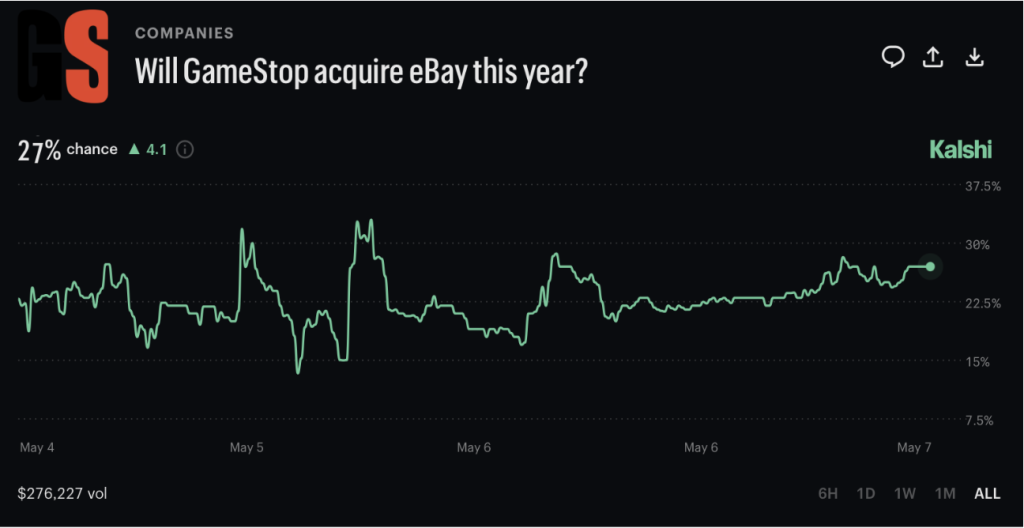
Why China tariff forecasts are cooling toward 17%
Tariff markets have become a premier macro trade on Kalshi as sentiment regarding US-China relations shifts weekly. The market is forecasting where US tariff rates on Chinese goods will land by July 1. This implied forecast has steadily declined from above 25% in early February to 17.7% heading into May.
The bulk of this move occurred in February and early March as traders aggressively priced out the likelihood of further escalation. Since then, the market has stabilized, spending two months hovering in the mid-to-high teens. The “between 10% and 19.99%” range is now the clear favorite at 68%, while the probability of tariffs landing between 20% and 29.99% has fallen to just 19%.
After a volatile start to the year, traders seem to be settling on a consensus: while tensions between Washington and Beijing remain elevated, the odds of a major near-term tariff spike have faded significantly.
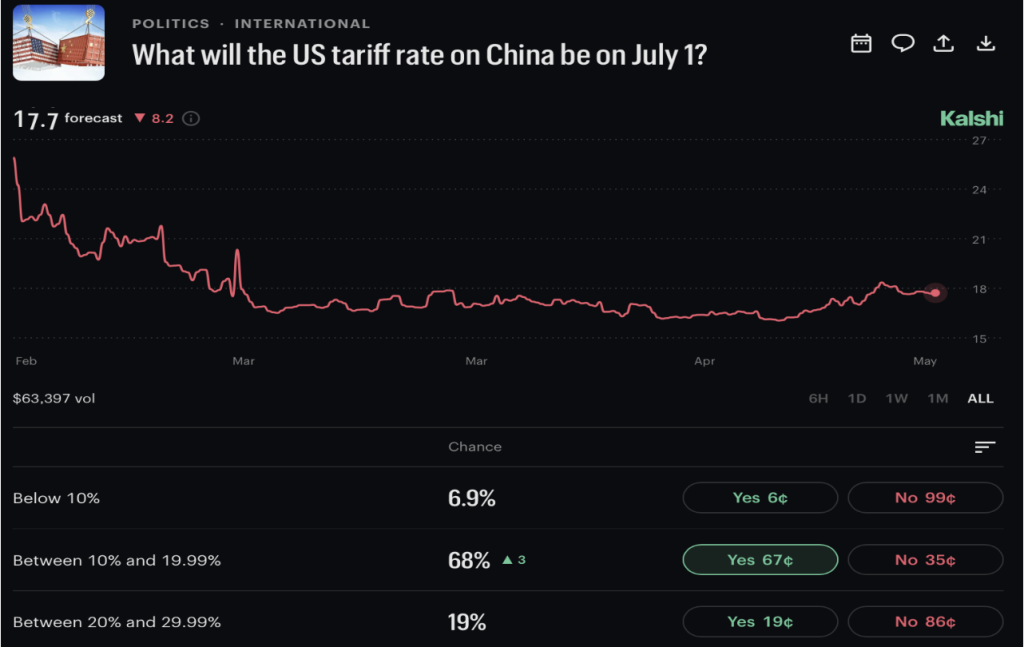
2026 World Cup outlook: Europe maintains dominance
World Cup markets are gaining early traction, defined by a clear theme: unwavering confidence in Europe. The market for which continent will win the 2026 Men’s World Cup has remained stable over the last two weeks, with Europe holding a dominant 70% implied probability.
This confidence stems from the depth of UEFA contenders. France, Spain, England, Germany, and Portugal are all viewed as legitimate title threats, providing Europe a broader path to victory than other regions. South America remains the primary challenger at 23%, driven by faith in Argentina and Brazil.
Notably, this market shows little volatility despite movement in individual team odds. Prediction market traders are treating Europe as the “safest” macro position, betting that the region simply possesses too many elite teams for the rest of the field to overcome.
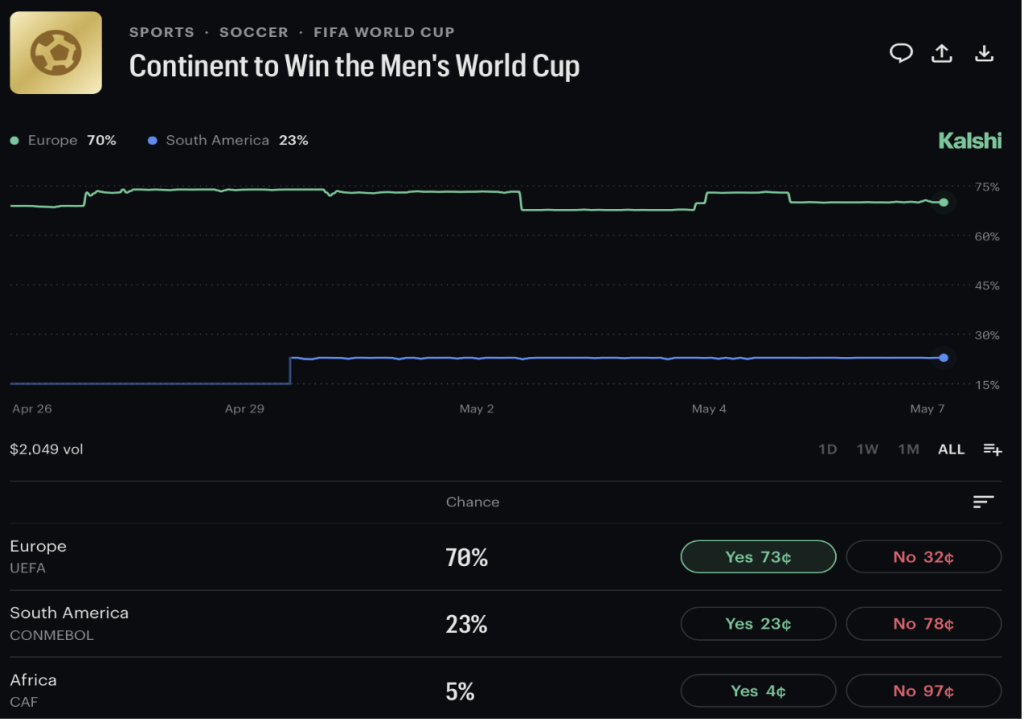
Traders price in longer shipping disruptions at Hormuz
The Strait of Hormuz market is one of Kalshi’s most volatile geopolitical trades, with traders constantly reassessing how quickly shipping traffic will stabilize. Confidence in a near-term recovery has fallen since mid-April.
At one point, the probability of traffic returning to normal before July 1 surged toward 80% amid cooling tensions. That optimism was short-lived; traders have since backed away, and the July contract now sits near 45%. The August and September timelines have proven more resilient, at 58% and 65%, respectively, suggesting the market expects normalization to take longer than initially hoped.
This market remains highly reactive to headlines regarding military positioning and shipping disruptions. It is currently split between those expecting a contained disruption and those pricing in the possibility that instability in this vital shipping lane could persist through the summer.
Pandemic risk drifts lower despite social media spikes
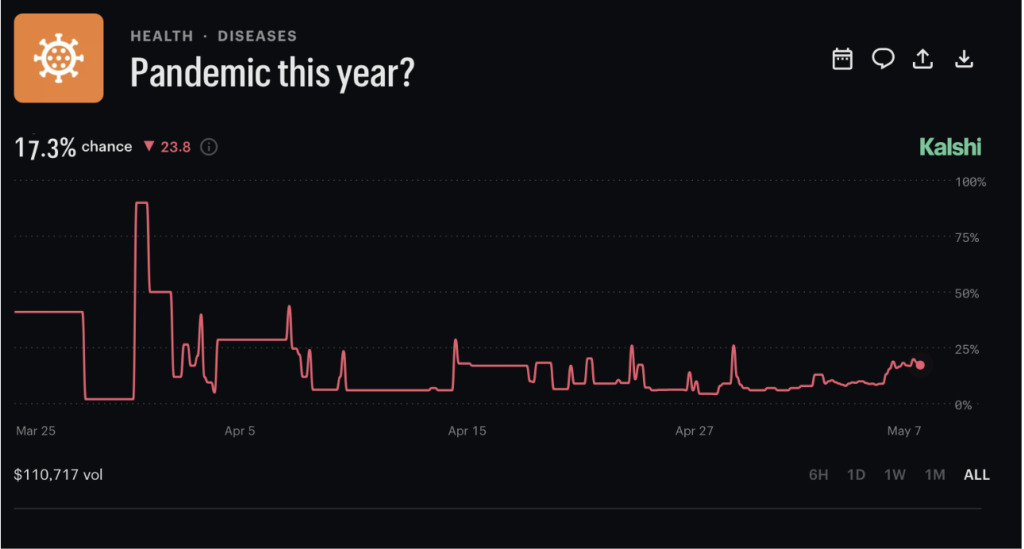
The pandemic market remains an outlier, with traders swinging between panic and skepticism. While the market currently reflects only a 17.3% implied chance of a pandemic being declared in 2026, the path to that figure has been erratic.
In late March, several spikes pushed probabilities toward 90% before an immediate collapse. The contract settled into the low-to-mid teens through April before ticking higher this week. Unlike stable macro markets, this contract reacts sharply to social media-driven outbreak chatter, even when broader public health fundamentals remain unchanged.
Each time probabilities have spiked, traders have quickly sold off the fear. The consistent drift back toward lower levels suggests most participants view an officially recognized pandemic in 2026 as unlikely.
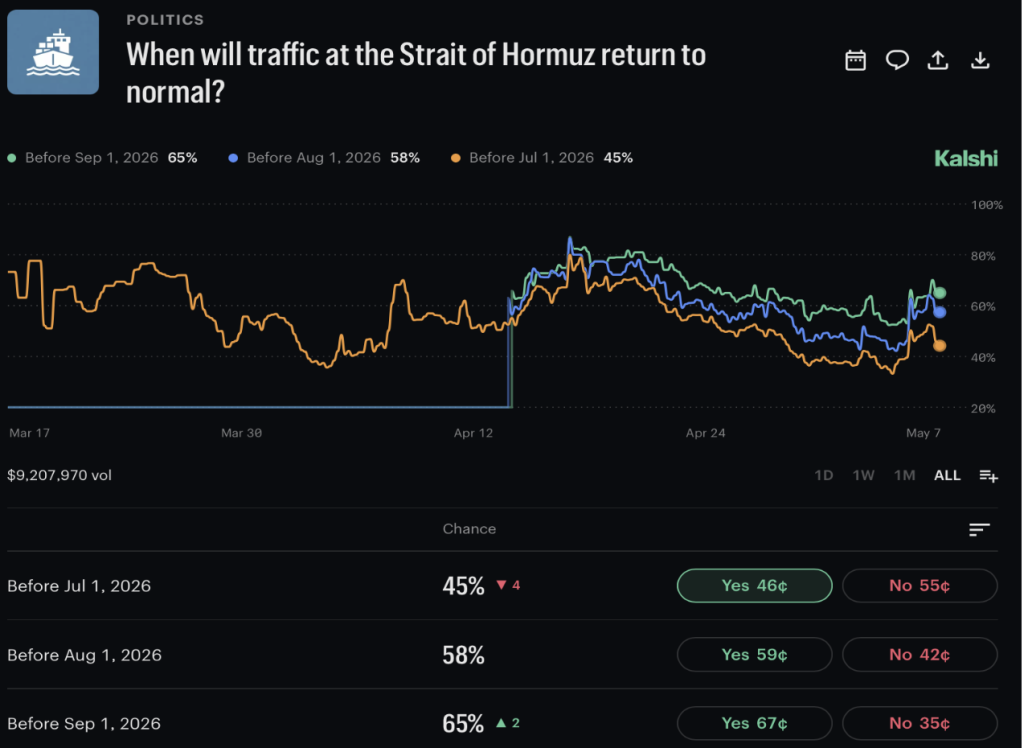
Decoding the GameStop-eBay acquisition speculation
One of the more bizarre trades this week involves speculation that GameStop will acquire eBay in 2026. Despite the inherent skepticism of such a deal, the market is active, with implied odds climbing to roughly 27% after several days of wild swings.
The contract has traded in a wide range, dipping to 15% before surging above 30% during heavy speculation. Current pricing in the mid-to-high 20s suggests traders aren’t fully dismissing the possibility, despite its unconventional nature from a corporate finance perspective.
This market is driven by narrative momentum rather than fundamentals. Headlines involving GameStop’s strategy or Ryan Cohen immediately trigger volatility. For now, the market serves as a gauge of trader willingness to entertain meme-stock culture and GameStop’s unpredictable trajectory.