


 Share



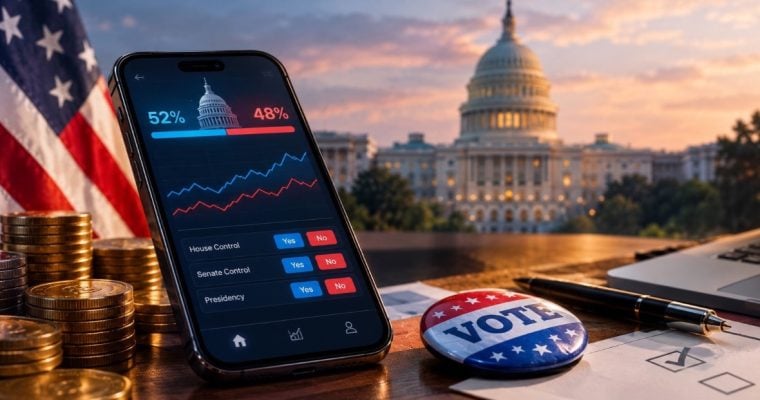
Political event contracts let people put real money on how an election turns out, like trading a stock or placing a sports bet.
The category is growing fast heading into the midterms, and PlayUSA asked a data analyst, a gambling policy expert, and a behavioral health provider what that growth actually means. They don’t always agree.
When elections come with a price
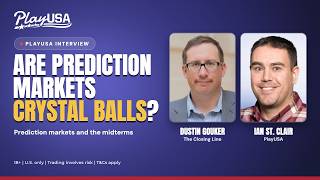
Dustin Gouker, Publisher of The Event Horizon, sees real analytical value in the numbers these prediction markets produce.
“Political markets aggregate polling, news, and information into a probability that is difficult to get to otherwise. The numbers that prediction markets give us are definitely novel and useful to see how a market prices outcomes,” he said. He’s not convinced it’s reshaping how most people consume political news just yet.
“I don’t think it’s a radical reframing of how we look at things… I still see far more reporting on polls than I do on prediction markets. But I think prediction markets are better at telling us how likely a candidate is to win a race, or who will control Congress, than polls are.”
Daniel Umfleet, Founder and CEO of Kindbridge Behavioral Health, frames the same shift in much more personal terms.
“Following an election used to cost most people nothing but attention. With money on it, a debate or a bad news cycle isn’t just frustrating anymore. It hits your bank account,” he said.
The emotional stakes compound the financial ones.
“People bet on elections they care about deeply, often as part of who they are. We know from gambling generally that when money is tied to something emotional, losses are harder to walk away from, and chasing them gets more tempting. Lose an election and lose money on it, and that’s two hits at once.”
He also points to the format itself:
“There’s also no natural stopping point. A game ends. Political news runs all day, and the app is always in your pocket.”
Brianne Doura-Schawohl, a longtime problem gambling policy expert who runs Doura-Schawohl Consulting, places the shift in a wider pattern she’s been tracking across industries.
“The shift in availability of election contracts is part of a broader cultural shift where gambling is infiltrating all aspects of life. We are increasingly seeing experiences that embody the risks and rewards we associate with gambling outside of traditional gambling environments,” she said. “As I have said before, just because something is not regulated like gambling doesn’t mean our brains decipher it differently.”
Election markets outpace gambling regulations
Gouker sees a gambling policy system built for a different era trying to keep up.
“Other than the widespread legalization of sports betting and daily fantasy sports, states generally apply existing laws to things like prediction markets and other things that either are or are adjacent to online gambling. Lots of states have express prohibitions on betting on elections, dating well before the internet even existed,” he said.
He thinks that mismatch is a structural problem, not just a messaging one.
“The growth of prediction markets has really underlined this dynamic. Betting exchanges would be good to have, but 1. they don’t work under a state-regulated model and 2. states don’t want to give up their ownership of gambling, which has fallen under their purview for most of US history.”
Umfleet traces the same gap to which federal body gets to decide what a political contract even is.
“Prediction markets came in through federal commodities regulators and argue state gambling law doesn’t apply to them. The practical result is that many behavioral health guardrails don’t come with them. Most let you start at 18. Protections are voluntary,” he said.
North Carolina is his go-to example of how lopsided that can get: “It legalized sports betting at 21 and funded treatment, and now it’s set to tax prediction markets at 6% of their fees, against 23% for its sportsbooks, with no state license. Meanwhile, there’s still no dedicated federal funding for gambling treatment at all.”
He sums up the dynamic bluntly: “Very little of this is being decided by people weighing the public health cost. It’s being decided in court cases about whether a contract counts as a financial product.”
Who’s trading, and the name nobody agrees on
Gouker’s read on who’s actually in these markets splits into two groups.
“I think people who care about politics and where the country is headed are probably the most engaged traders on election markets. There’s also probably some people who just like to gamble and speculate,” he said. His bigger worry isn’t who’s trading; it’s what happens when a favorite loses.
“I fear election markets might be misused if underdogs end up winning. If a prediction market says someone was favored to win but they don’t, does that get weaponized to try to [sow] distrust? It’s a possible outcome.”
Umfleet’s clinical read on who’s trading lines up with a group his field already knows.
“The users skew young and male, the same group we already see in treatment for sports betting,” he said.
He flags a gap between how the public labels this activity and how the people in trouble with it describe it.
“Polling shows most Americans see prediction markets as gambling. In treatment, we’re seeing more people who think of it as investing. The app calls it trading and looks like a brokerage,” he said.
That mismatch has real consequences.
“If you don’t see it as gambling, you don’t call a gambling helpline or self-exclude, and when a clinician asks ‘do you gamble?’ you say no.”
His biggest concern is about the entry point, not any single market.
“My biggest worry is that politics becomes a front door. Someone downloads an app for a Senate race, and the same account offers sports and hundreds of other markets every day.”
Doura-Schawohl ties that same blurring to how young people are being asked to make sense of all of it.
“How do we address this rapidly evolving concept of what gambling entails with our children? How do we teach them to evaluate the benefits and drawbacks of these activities and how to discern between gambling for entertainment and investing for long-term financial gain?” she said. “There have always been broad conversations about how stock trading and gambling relate, but we are fast approaching an era where the lines between gambling, investing, trading, collecting, and gaming are completely blurred.”
Election night becomes the ultimate stress test
For Gouker, the midterms are less a human-stakes event than a credibility test for the markets themselves.
“Prediction markets have consistently shown Democrats to be pretty big favorites to win the House. If Republicans win, that won’t make them wrong, per se, if Dems have a 90% chance to take the House, that means R’s will win 10% of the time,” he said.
Still, he thinks the industry has set itself up for scrutiny either way.
“Prediction markets have hung their hat on the idea that they are crystal balls, and that they are ‘more accurate than polls.’ If there’s not a blue wave, that’s perhaps less than ideal both for prediction markets and polls.”
Umfleet is watching the same night from the treatment side, and he’s less worried about market credibility than about what happens after the results come in.
“With money on the outcome, a loss can mean grief, anger, and a financial hit at once. That’s when people start chasing losses or hiding them,” he said.
He’s also watching the weeks that follow, not just election night itself.
“After the 2024 election, we saw anxiety and stress tied to the outcome rise for months, both in people already in care for gambling and in people coming in new. Money on the result should make that sharper.”
He offers a clear marker for what would count as progress.
“A good surprise would be platforms moving to 21, making protections standard, and helping fund treatment like their licensed competitors do through state taxes. A bad surprise would be getting through this cycle with nothing changing about how we screen for it or who pays for care.”
The midterms won’t settle this debate
Three people, three different vantage points, and not much agreement beyond the fact that this category is growing fast.
Gouker sees a genuinely useful forecasting tool still finding its footing, with regulation struggling to keep pace. Doura-Schawohl sees one more front in a culture where gambling-shaped risk is showing up in places that were never regulated as gambling. Umfleet sees a specific, familiar pattern: young, male, convinced it’s investing rather than betting, moving through a system with almost none of the guardrails sports betting eventually got.
None of them think the midterms will settle the argument. What they’re actually watching for is what happens to the people trading through it, win or lose.