


 Share
Share 



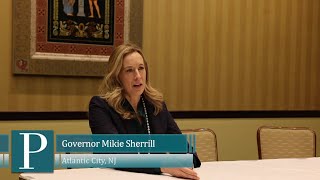
Gov. Mikie Sherrill has stepped into one of Atlantic City’s longest-running labor disputes, but she isn’t offering a verdict just yet. Rather than taking a definitive stance on indoor smoking at casinos, Sherrill is calling on state lawmakers to resolve the matter through legislation rather than litigation.
Sherrill laid out her position in a recent interview with The Press of Atlantic City. Her remarks inject fresh energy into a perennial clash between casino employees, industry executives, and public health advocates.
History of NJ’s Smoke-Free-Air Act casino exemption
The conflict dates to 2006, when New Jersey passed the Smoke-Free Air Act. While the law banned indoor smoking in most workplaces, it carved out an exception for Atlantic City casinos, allowing tobacco use on up to 25% of gaming floors. Crucially, the law did not require physical barriers between sections, allowing secondhand smoke to drift into non-smoking areas.
When COVID-19 mask mandates were lifted in 2021 and smoking resumed, a group of workers formed Casino Employees Against Smoking (CEASE). The organization has since campaigned to close the exemption, arguing that workers should not have to choose between their health and their livelihoods.
CEASE members contend the exemption violates equal protection guarantees under the New Jersey Constitution. They are backed by the United Auto Workers, which represents dealers, slot attendants, and other frontline staff.
Governor calls for hearings, not a verdict
Despite prior statements appearing sympathetic to the workers, Sherrill declined to take a side during her recent interview. She told the Press that both sides of the workforce raised valid concerns.
While many employees want a smoke-free environment, others fear a ban could hurt business and cost jobs.
“We need to protect worker safety while making sure jobs remain and the economy continues to grow,” Sherrill said. “That requires hearings.”
Sherrill added that her administration is in talks with legislative leaders regarding a timeline. She emphasized that any solution must ensure workers are not put at risk or forced out of the industry.
The governor’s stance drew a sharp response from CEASE co-founder Nicole Vitola. “The time for discussion has passed,” Vitola said, calling on the governor to drop the administration’s opposition to the workers’ ongoing lawsuit.
Comparing SB 212 vs. SB 698: Two bills, two approaches
Inside the Statehouse, the debate has produced competing proposals:
- SB 212: Introduced by Sen. Shirley K. Turner, this bill calls for a full prohibition on smoking inside casinos and simulcasting facilities. It would remove all exemptions 90 days after being signed into law.
- SB 698: Introduced by Sen. John J. Burzichelli, this measure suggests an incremental approach. Smoking would be restricted to enclosed, separately ventilated areas or sections limited to slot machines. Smoking would be prohibited within 15 feet of any live table game.
The Casino Association of New Jersey, representing the city’s nine operators, has lobbied heavily to preserve current allowances. Their primary concern is competition.
With Philadelphia casinos permitting smoking and three new New York City casinos in development, the industry warns a ban could drive gamblers elsewhere. Operators noted that while in-person gaming revenue dipped in 2024, it only saw a modest recovery in 2025.
Appeals court revives casino workers’ equal protection lawsuit
As the legislative process stalls, CEASE’s legal case remains a threat to the status quo. According to a report by PlayNJ, a New Jersey appeals court recently ruled that a constitutional equal protection claim—previously dismissed—must be reconsidered.
The appeals court sent the case back to the trial court, finding the previous dismissal lacked a proper examination of the factual record. With the courts re-engaging and the Legislature under pressure, the window for a political compromise is narrowing. For workers who have spent years breathing secondhand smoke, the question is no longer if change is coming, but how soon.