



 Share
Share 



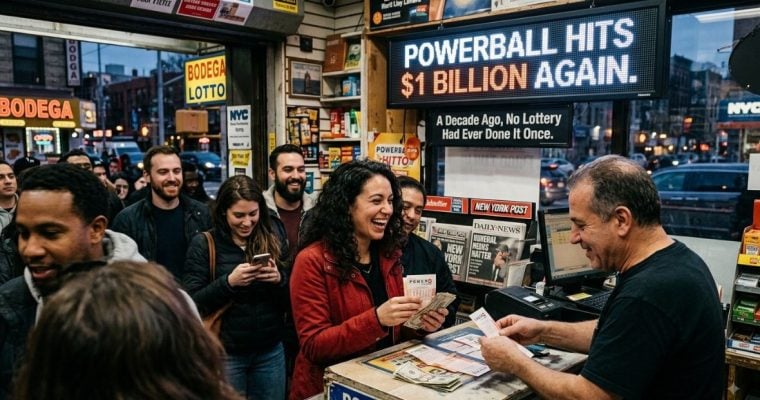
Powerball reached $1 billion for Wednesday night’s drawing after Monday’s roll, the 43rd straight drawing without a jackpot winner. Wednesday’s will be the 44th.
Ten years ago, this would have been the biggest lottery story in American history. Now it is roughly the third such story in 12 months.
Powerball sold tickets for 23 years and nine months before it produced a single billion-dollar jackpot. Since that first one — the $1.586 billion split three ways in January 2016 — American lotteries have advertised a $1 billion prize 15 times. Three of those have come since September.
The gaps between them are shrinking. The first eight billion-dollar jackpots arrived an average of 395 days apart. The last seven have averaged 157.
That is not a run of luck. It is the product of four deliberate changes to how Powerball is structured, and it comes with a natural experiment attached: Mega Millions made the opposite choice last year and has not reached $1 billion since.
Get a Free Ticket on First Play
Order Tickets on Your Phone
Get a Free Ticket on First Play
Order Tickets on Your Phone
$10 in Bonus Lottery Credits (Min. $5 Deposit)
Available on iOS & Android
$10 in Bonus Lottery Credits (Min. $5 Deposit)
Available on iOS & Android
How to buy a ticket before Wednesday’s drawing
Powerball is sold in 45 states, Washington DC, Puerto Rico, the US Virgin Islands and, since July 21, the United Kingdom. US tickets are $2, plus $1 for Power Play. The drawing is at 10:59 p.m. ET.
Cutoffs come earlier than you’d think.
- Washington stops sales at 6:45 p.m. PT — 9:45 p.m. ET, more than an hour before the draw.
- California cuts off at 7 p.m. PT
- Texas sales end at 9 p.m. CT
- Colorado ends at 7:30 p.m. MT
- Florida sells until 10 p.m. ET
- Courier apps close their windows earlier still.
Most states require you to be 18. Nebraska is 19; Arizona, Iowa, Louisiana and Mississippi are 21.
Online through official state lotteries
Roughly a dozen jurisdictions sell Powerball directly through their own site or app, including Georgia, Illinois, Kentucky, Michigan, New Hampshire, North Carolina, Pennsylvania, Virginia, West Virginia, Connecticut, Tennessee and DC. Massachusetts joined on July 27, with an unusual split age rule: 21 and up online, but 18 at retail. Maryland, New York and North Dakota offer subscriptions rather than single online tickets.
All of them require you to be physically inside the state when you buy, verified by geolocation. You generally do not need to be a resident.
Using online lottery courier apps
Jackpocket, Jackpot.com and Lotto.com buy a physical ticket for you at a licensed retailer and store it in a vault. Jackpocket operates in 17 jurisdictions, Lotto.com in 12 and Jackpot.com in seven. Only New Jersey and New York license and regulate online lottery couriers; most states where they operate have no statute either way.
Several states have shut the door. Wisconsin bans courier services outright by statute and allows ticket sales only for cash. California’s lottery told retailers in 2024 that couriers are illegal and that it will not pay prizes on courier-bought tickets. Indiana banned them in 2025, Mississippi’s attorney general found them unauthorized, and Florida shut down theLotter‘s service.
Texas went furthest. After a courier-placed $83.5 million win in early 2025, the state prohibited couriers, abolished the 30-year-old Texas Lottery Commission, moved the game under the Department of Licensing and Regulation, made online or courier sales a Class A misdemeanor, and capped in-person purchases at 100 tickets. A Texan buying on Wednesday must do it in person.
How to play Powerball in the UK
British players buy through the National Lottery website, app or an authorized retailer at £4 per line, with entries closing at 11:55 p.m. UK time and the draw landing around 4 a.m. Thursday there.
The UK game shares only the jackpot; every lower tier pays a fixed sterling prize funded separately, including £1 million for matching five and an £8 tier for matching two, with no US equivalent. That extra tier improves the overall odds of winning something to about 1 in 14, against 1 in 24.9 in the US. Jackpot odds are identical at 1 in 292,201,338.
UK winners have no lump-sum option at all. The prize is paid as a 30-year rising annuity. And the UK advertises the estimated amount a winner actually receives after currency conversion and US withholding, which is why the same prize pool showing $1 billion in America is advertised at roughly £500 million in Britain.
One caution for British players searching for the game: several lookalike sites advertise a “UK Powerball” at different prices and draw times. The only legitimate routes are the National Lottery website, its app and authorized National Lottery retailers.
Every billion-dollar jackpot: complete timeline
| # | Game | Date | Amount | Days since the last one |
| 1 | Powerball | Jan. 13, 2016 | $1.586B | — |
| 2 | Mega Millions | Oct. 23, 2018 | $1.537B | 1,014 |
| 3 | Mega Millions | Jan. 22, 2021 | $1.050B | 822 |
| 4 | Mega Millions | July 29, 2022 | $1.337B | 553 |
| 5 | Powerball | Nov. 7, 2022 | $2.040B | 101 |
| 6 | Mega Millions | Jan. 13, 2023 | $1.348B | 67 |
| 7 | Powerball | July 19, 2023 | $1.080B | 187 |
| 8 | Mega Millions | Aug. 8, 2023 | $1.602B | 20 |
| 9 | Powerball | Oct. 11, 2023 | $1.765B | 64 |
| 10 | Mega Millions | Mar. 26, 2024 | $1.128B | 167 |
| 11 | Powerball | Apr. 6, 2024 | $1.326B | 11 |
| 12 | Mega Millions | Dec. 27, 2024 | $1.269B | 265 |
| 13 | Powerball | Sept. 6, 2025 | $1.787B | 253 |
| 14 | Powerball | Dec. 24, 2025 | $1.817B | 109 |
| 15 | Powerball | Aug. 12, 2026 | $1 billion | 231 |
Counting jackpots advertised at $1 billion or more. Sequence numbers 1–14 are prizes that were won; No. 15 is Wednesday’s.
Two things jump out. The first four took six and a half years. Numbers five through eleven took 17 months. And the whole back half of that list belongs increasingly to one game — Powerball has produced five of the last seven, including all three since September 2025.
Change one: they made it harder to win
On Oct. 4, 2015, Powerball rebuilt its number matrix, with the first drawing under the new format on Oct. 7. White balls went from 59 to 69. Powerballs went the other way, from 35 down to 26.
The effect was to stretch the jackpot odds from 1 in 175,223,510 to 1 in 292,201,338 — about 67% longer — while improving the odds of winning any prize at all, from 1 in 31.85 to 1 in 24.87.
Lottery officials were entirely candid about why. The Louisiana Lottery published its announcement under the headline “Powerball’s Matrix Changes to Build Bigger Jackpots.” Its president at the time, Rose Hudson, explained the logic:
“Since then, the game’s playing population has grown to include 47 lottery jurisdictions, and jackpots are consequently hit faster. This change will help produce those eye-popping jackpots that players have come to expect with Powerball.”
Longer odds mean fewer winners. Fewer winners mean longer rollover streaks. Longer streaks mean bigger jackpots. The Massachusetts State Lottery described the goal as producing “larger jackpots and add more winning experiences.”
Three months later, Powerball hit $1.586 billion.
Change two: a third drawing every week
On Aug. 23, 2021, Powerball added Monday drawings, going from two a week to three. May Scheve Reardon, then chair of the Powerball Product Group, put it plainly:
“Players have let us know they want to play for bigger jackpots and cash prizes, and we want Powerball to deliver on their expectations.”
The per-drawing odds didn’t change, so this didn’t make jackpots more likely to grow — it made them grow faster in calendar time. A run of a given number of rolls now burns through in about two-thirds the days it used to. Wednesday’s 44-drawing streak stretches back to May 2. Under the old twice-weekly schedule, the same number of drawings would have taken until roughly late September.
Change three, the underrated one: no guaranteed floor
This is the change almost nobody writes about, and it may be the most important.
Powerball used to start at a guaranteed $40 million and roll by a guaranteed minimum of $10 million between drawings. In March 2020, as COVID crushed retail sales and interest rates collapsed, it cut those to $20 million and $2 million. A week later, on April 2, 2020, it scrapped the guaranteed minimums altogether.
Gregg Mineo, then the Product Group chairman, framed it as survival:
“These changes are necessary to ensure that ticket sales can support the Powerball jackpot and other lower-tier cash prizes.”
What it actually created was a snowball. Jackpot growth is now indexed to sales and interest rates rather than a fixed increment. And because ticket sales rise steeply with jackpot size, each roll feeds the next: early rolls are small, late rolls are enormous. The current run started from a $20 million reset on May 2 and has added $980 million since, most of it in the last few weeks.
Change four: expanding into the UK
On July 21, Powerball began selling tickets in the United Kingdom through Allwyn’s National Lottery — the 49th participating lottery and the first outside the United States ever to feed the Powerball jackpot. UK sales contribute only to the jackpot pool; British players have their own separately funded lower-tier prizes.
Powerball has been careful about what it discloses. In announcing Wednesday’s $1 billion, Stephen Durrell, the current Product Group chair and Kansas Lottery executive director, said sales for Monday’s drawing “exceeded expectations and increased more than 86% compared to the previous Monday drawing,” and that the game continues “to see strong participation from both new players in the United Kingdom and millions of Americans.”
What Powerball has not released is any split between US and UK sales, so how much of that 86% is genuinely new British money and how much is ordinary billion-dollar frenzy is unknown.
The control group: Mega Millions went the other way
Here’s what makes the case more than a theory. Mega Millions ran nearly the same experiment in reverse and got the mirror-image result.
In April 2025, Mega Millions raised its ticket price from $2 to $5. It also did everything you would do to help a jackpot grow: shortened the odds to 1 in 290,472,336, raised the starting jackpot from $20 million to $50 million, and baked a 2X-to-10X multiplier into every non-jackpot prize. The consortium projected average jackpots above $800 million, up from roughly $450 million.
It hasn’t reached $1 billion since. Its last billion-dollar prize was $1.269 billion in December 2024 — three months before the change.
Massachusetts Lottery executive director Mark William Bracken named the mechanism:
“The single most important factor in Mega Millions sales is the size of the jackpot. Since the introduction of the new game matrix, the Mega Millions jackpot has yet to reach $1 billion, which is where we typically see a significant increase in sales.”
Massachusetts Mega Millions sales fell 24% in the year after the change, from $111.3 million to $85 million. A working paper by economists Karsten Hansen (UC San Diego), Kanishka Misra (Boston College) and Vishal Singh (NYU Stern), built on retailer data from New York and Texas plus point-of-sale data from about 13,800 convenience stores, found revenue down 23% to 28%. In New York, tickets sold per drawing fell from roughly 1.9 million to about 560,000 — a two-thirds collapse in volume.
Their description of the loop is the thesis of this whole story, running backward: “Lower current sales slow jackpot growth; slower jackpot growth depresses future demand.” They attribute about half the revenue loss to that feedback cycle, and calculate the profit-maximizing price would have been between $3.30 and $3.90.
Powerball lengthened its odds, added drawings, removed its guaranteed floor and expanded its player pool. Mega Millions shortened its odds and raised its starting jackpot but tripled its price. Powerball is at $1 billion tonight. Mega Millions hasn’t been there in 20 months.
The variable that matters most isn’t the odds. It’s ticket volume feeding a sales-indexed roll.
Why $1 billion is the new threshold
The demand side explains the engineering. Victor Matheson, an economics professor at the College of the Holy Cross who studies lotteries, estimates Americans are 15 times more likely to buy a ticket when a jackpot approaches $1 billion than when it sits at $20 million. On the gradual lengthening of the odds, he is blunt: “They’ve been running Powerball or its predecessor for [34 years], and they’ve gradually been making it harder and harder to win.”
And on why smaller prizes can’t do the work: “You’re not writing any stories about the person who won $4.”
The industry term for the problem is jackpot fatigue, and it has been creeping upward for 30 years. What’s notable now is where the trigger point has landed. Ohio Lottery spokesperson Danielle Frizzi-Babb has said, “the levels that you would think would drive traffic don’t really anymore,” with Ohio officials putting the point where sales genuinely move at above $1 billion. Bracken, in Massachusetts, independently named the same figure. Two state lotteries a thousand miles apart identifying the identical threshold suggests it’s real.
Which means the engineering has to keep running. A prize that reliably moved tickets at $300 million a decade ago now needs to be three times bigger to do the same work.
The reality check: a billion isn’t what it was
There’s an unglamorous reason billion-dollar jackpots feel more common, and it isn’t only game design.
Using CPI, the $1.586 billion Powerball of January 2016 is worth about $2.24 billion in 2026 dollars. Run it the other way and Wednesday’s $1 billion is worth roughly $710 million in January 2016 money — well under half the real value of the jackpot that started the billion-dollar era.
Tonight’s prize ranks eighth all-time in nominal Powerball history. Adjusted for inflation, it ranks lower still.
Monday’s winning numbers
The Aug. 10 numbers were 6, 37, 54, 55 and 64, with a Powerball of 10 and a 3x Power Play multiplier.
No one matched all six. One ticket hit all five white balls with Power Play for $2 million, and two more won $1 million. The jackpot was last won May 2, when tickets in Florida and Texas split a $20 million prize at the reset level.
Powerball’s most frequently drawn numbers
Across 1,392 drawings since the current 69/26 matrix began on Oct. 7, 2015, the most frequent white balls are:
| Number | Times drawn |
| 61 | 124 |
| 21 | 123 |
| 64 | 122 |
| 28 | 119 |
| 27 | 117 |
| 36 | 117 |
The most common Powerballs are 4 (66 times), 14 (65) and 21 (63). The coldest white ball is 13, at 75 appearances; the coldest Powerball is 16, at 40. Monday’s draw leaned hot — 64 is the third most-drawn white ball in the matrix’s history.
Worth saying plainly: none of this predicts anything. Each white ball should turn up about 101 times by chance, with a standard deviation near 10. The hottest number sits 2.4 standard deviations above expectation and the coldest 2.7 below — across 69 balls, exactly the spread randomness produces.
What can change your payout is who else picked your numbers. Research on lottery number choice consistently finds players cluster on low digits and calendar dates, so only 31 of the 69 white balls fall in the birthday range and higher numbers are systematically under-played.
The classic illustration came on March 30, 2005, when 110 people matched all five white balls in one Powerball drawing — every one of them playing 22, 28, 32, 33 and 39, the numbers printed inside Wonton Food’s fortune cookies. They missed the jackpot only because the cookie’s sixth number was 40 and the Powerball drawn was 42.
Between 70% and 80% of tickets are quick picks, and the same share of winners are quick picks. The win rate simply mirrors the sales rate.