



 Share
Share 



New York legislators are moving on multiple fronts to reshape how the state’s sports betting industry operates. Their responsible gambling proposals cover everything from how operators settle injury-affected wagers to how they advertise their products in public spaces.
At the center of that effort is Assembly Bill A11414, sponsored by Assemblymember Jordan Wright. The bill was referred to the Assembly Racing and Wagering Committee on May 15.
If approved, the measure would compel licensed online sportsbooks operating in New York to adopt what Wright calls a “fair play policy.” A11414 proposes that when something outside a bettor’s control derails a wager, operators should follow a clear, consistent set of rules for handling it.
Standardizing how operators respond to disruptions
Right now, sportsbooks largely set their own standards for settling bets tied to players who get injured or withdrawn from a game. Some operators void those tickets. Others grade them as losses. Wright’s bill aims to remove that inconsistency.
It would task the New York State Gaming Commission with writing regulations that all licensed operators must follow when unforeseen events affect a wager’s outcome. The covered scenarios go beyond injuries. Player withdrawals, event cancellations, suspensions, and statistical or scoring corrections would all fall under the policy’s scope.
One notable feature of the bill is its automatic trigger requirement. Operators would need to apply refunds, voids, or adjustments on their own, without waiting for a bettor to file a request, “where reasonably practicable,” per the bill’s language. The policy would also have to be applied consistently across all similarly situated bettors, preventing selective enforcement.
Before any bet is placed, operators must clearly disclose their fair play terms. Those terms would also need to be easily accessible on websites and mobile apps.
Many sportsbooks already offer some version of injury protection. Same-game parlay insurance and early payout features have become fairly common selling points. But those are optional promotions that operators extend at their own discretion. If A11414 passes, such protections would no longer be optional. They would become a legal baseline across the entire New York market.
Other NY sports betting bills under debate
A11414 is not the only sports betting proposal drawing attention this session.
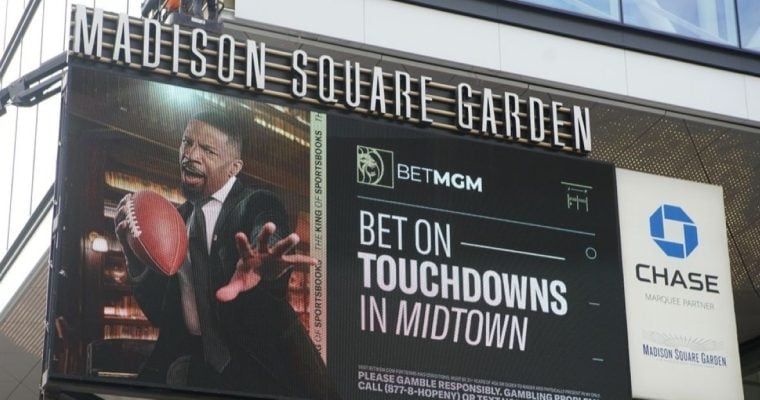
State Sen. Nathalia Fernandez has introduced two related measures. The first, S10400, would prohibit billboard advertisements for sports betting and gambling products on outdoor structures visible to the public. It extends similar prohibitions to alcohol, tobacco, nicotine, and vaping ads.
Fernandez’s other bill, S10401, would require operators to replace expired billboard contracts with public service announcements. The announcements would be required to address the potential harms associated with those products, rather than simply rotating in new ads.
State Sen. Andrew Gounardes has introduced S10470, which would prohibit online sports betting on New York college campuses. Gounardes has argued the measure would limit students’ exposure to gambling and reduce distractions in academic settings. Illinois, Massachusetts, and Ohio have each passed restrictions related to betting on college campuses in recent years.
Two other bills round out the session’s sports betting reform package. A9343 would ban live, in-play wagering, or micro-betting. A7962 would cap how often bettors can add funds to their accounts and restrict when operators can run advertisements.
Earlier this year, Gov. Kathy Hochul separately proposed requiring biometric verification for sportsbook account logins. The New York State Gaming Commission opened a public comment period on that proposal, which recently closed. The goal is to keep users under 21 off licensed platforms.
New York’s key role
As originally reported by PlayNY, none of these bills has reached a floor vote. Most are still working through committee. But taken together, they reflect a Legislature that is paying closer attention to how New York’s betting market functions and who it may be leaving unprotected.
For bettors, the stakes are fairly concrete: more predictable rules, clearer disclosures, and fewer situations where the outcome of a dispute depends entirely on which app they happened to use.
New York launched mobile sports betting in January 2022 and has since become the country’s largest legal wagering market by total handle. That position gives its regulatory decisions an outsized influence. What New York mandates tends to get watched closely by other states still refining their own frameworks.