



 Share
Share 



State of Play’s TL;DR
- A Galaxy report on 2.9 million Polymarket retail-like accounts found that 69.2% finished below break-even.
- The group lost $338.9 million in aggregate.
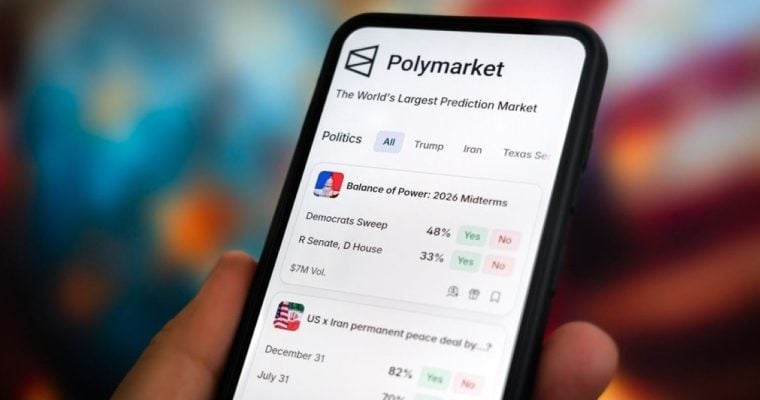
Galaxy says 69.2% of analyzed retail-like Polymarket accounts finished below break-even, with the group losing $338.9 million in aggregate across the platform’s onchain settlement history.
The report matters offers one of the clearest public looks at how retail users have fared on a major prediction market as Polymarket rebuilds a US presence through a CFTC-licensed subsidiary. It also highlights a sharp split between typical users and automated traders.
Galaxy said Polymarket’s international platform has matched 1.27 billion orders across 3.07 million wallets, representing $82.8 billion in notional volume. For its core analysis, the firm narrowed that universe to 2.9 million accounts it said traded like people rather than bots.
A quoted takeaway in the report summarized the result this way:
“69% of retail accounts finish below break-even (at a loss) and the population is down $339m in aggregate.”
Galaxy also said the median retail account was down about $3.00, with the middle half of outcomes ranging from -$36.64 to +$0.40.
Losses, churn, and specialization stood out in the data
Galaxy found that losing traders were more likely to stop participating, at least temporarily. After a loss, 15.2% of accounts had not traded again within 30 days, compared with 6.1% after a win.
The report also found that 44.1% of traders concentrated more than 60% of their activity in a single topic area. That specialization did not produce the same results across categories. According to Galaxy, sports specialists were the least profitable group, while tech and science specialists were the most profitable.
Position size also appeared to matter. The median position for profitable traders was $13.96, versus $10 for unprofitable traders, according to the report.
Automated accounts captured much of the volume and profits
Galaxy said 125,429 accounts, or 4.1% of total accounts, were classified as automated and removed from the retail-style analysis. Even so, those accounts represented 80.8% of all orders and 41% of all notional volume, and they finished up $246.8 million in aggregate.
That gap is notable for operators and regulators because it suggests much of the market’s activity and profitability may sit outside the experience of ordinary users.
The report also notes that Polymarket re-entered the US through a CFTC-licensed subsidiary and introduced taker fees in early 2026. Its US app uses a separate order book from the international platform covered in the analysis, meaning the findings do not directly describe performance on the US product.
Galaxy said in the report’s outlook section:
“Nothing in this report undermines the case for [prediction markets] as truth machines.”
For the industry, the nearer-term question is whether newer fees, a separate US book, and competition from platforms including Kalshi change those retail trading outcomes over time.
Based on reporting by Galaxy.