



 Share
Share 



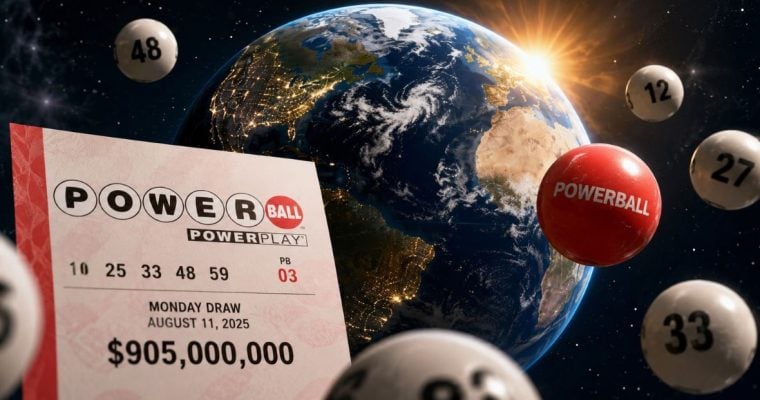
Nobody won Saturday night, so Powerball rolls into Monday with an estimated $905 million on the line. That makes it the eighth-largest jackpot in the game’s 34-year history.
It is also something no Powerball jackpot has ever been before: the largest prize ever contested by players on both sides of the Atlantic.
Powerball tickets went on sale in the United Kingdom on July 21, with British players first eligible for the July 22 drawing. Every jackpot run since has been a genuinely international affair, the first time in lottery history that a game outside the United States pays into the Powerball jackpot pool. But until now, none of those runs had produced a headline number worth talking about globally.
Monday’s does. At $905 million, with a cash value of $391.9 million, this is the first true mega-jackpot of Powerball’s global era.
Get a Free Ticket on First Play
Order Tickets on Your Phone
Get a Free Ticket on First Play
Order Tickets on Your Phone
Get up to $20 in Credits if Your First Order Isn't a Winner
Available on iOS & Android
Get up to $20 in Credits if Your First Order Isn't a Winner
Available on iOS & Android
What happened in Saturday’s Powerball drawing
Saturday’s numbers were 5, 9, 35, 54 and 63, with a red Powerball of 7. The Power Play multiplier came up 3x.
No ticket matched all six. The jackpot finished at $863.8 million once final sales were counted, above the $856 million estimate, the kind of upward revision that signals heavy late buying.
Five tickets came one number away. Players in Arizona, Florida, Michigan and New York each matched all five white balls for $1 million, and a Texas ticket did the same with Power Play added for $2 million.
How to buy Powerball tickets online before the drawing
Ticket sales cut off well before the 10:59 p.m. ET drawing, and the deadline varies by jurisdiction, typically between one and two hours ahead. Check your state’s cutoff rather than assuming.
You can buy Powerball tickets online in a growing number of states, through two different mechanisms:
Official state online lottery platforms sell draw games directly. That includes Connecticut, Georgia, Illinois, Kentucky, Michigan, New Hampshire, North Carolina, Pennsylvania, Virginia, Washington D.C. and West Virginia. Maryland, New York and North Dakota offer online subscriptions rather than single-drawing purchases. Massachusetts has legalized an online lottery that has not launched yet.
Online lottery courier services buy a physical ticket on your behalf and send you a scan of it. Jackpocket has the widest footprint, operating in Arizona, Arkansas, Colorado, Idaho, Maine, Massachusetts, Minnesota, Montana, Nebraska, New Hampshire, New Jersey, New Mexico, New York, Ohio, Oregon, Puerto Rico, Washington D.C. and West Virginia.
Jackpot.com serves Arizona, Colorado, Massachusetts, New Jersey, New York and Ohio. TheLotter operates in Arizona, Minnesota, New York and Oregon.
In every case you must be physically located within the state at the time of purchase and old enough to play: 21 in Arizona, Iowa, Louisiana and Mississippi, 19 in Nebraska, and 18 everywhere else. You do not need to be a resident. Geolocation software verifies where you are, so a VPN will get your purchase declined rather than approved.
Powerball’s first big jackpot run as a global game
The timing is close to perfect for Powerball’s operators. The UK launch landed on July 21, deep into one of the longest jackpot droughts in the game’s history. No one has hit the jackpot since May 2, a $20 million prize split between tickets in Florida and Texas, and 34 drawings had already come and gone without a winner by the time British players got their first crack at it.
That means UK players entered a game where the jackpot was already at $567 million, and have watched it climb to $905 million over eight drawings since. As introductions go, it is a fairly compelling one.
The commercial logic behind the expansion was never subtle. Powerball’s jackpots grow from sales, and sales had been capped for years by geography: 45 states, Washington D.C., Puerto Rico and the U.S. Virgin Islands. Adding roughly 69 million potential customers in a country with an established national lottery habit changes that ceiling.
“More players means faster-growing jackpots, more excitement and even greater impact for the communities we serve,” Tennessee Lottery President and CEO Rebecca Paul said when the launch was announced.
More players also means jackpots get won sooner, in theory, more tickets covering more of the 292.2 million possible number combinations. That has not happened yet. Eight drawings into the global era, the drought has only deepened, and Monday makes nine.
The UK is playing a different game than you are
Here is the part most coverage has skipped: a British Powerball ticket and an American Powerball ticket are not the same product.
The surface details match. UK tickets cost the equivalent of $2. Players pick five numbers from 1 to 69 and one Powerball from 1 to 26. The odds of hitting the jackpot are identical at 1 in 292.2 million. The drawings happen at the same time — Monday, Wednesday and Saturday at 10:59 p.m. ET, which is an inconvenient 3:59 a.m. in London.
Below the jackpot, the games diverge completely. UK ticket sales feed only the jackpot pool. They do not contribute to Powerball’s lower-tier prizes, and UK players are not eligible for them. Instead, Allwyn UK, which operates the National Lottery, runs an entirely separate lower-tier prize structure for British players.
So when a Texas ticket won $2 million on Saturday for matching five white balls with the Power Play multiplier, that prize existed in a pool British players have no access to. And vice versa.
No lump sum for a British winner
The single biggest difference concerns the money itself.
An American who wins Monday’s jackpot chooses between the advertised $905 million annuity, 30 graduated payments over 29 years, each 5% larger than the last, averaging about $30.2 million, or a one-time cash payment of $391.9 million. Nearly every U.S. jackpot winner takes the cash.
A British winner does not get that choice. UK jackpot winners are paid over a 30-year annuity, full stop. There is no lump-sum option.
That is a meaningful asymmetry for two people holding mathematically identical tickets. It also makes the two countries’ headline numbers impossible to compare directly, because the US advertises jackpots as pre-tax annuity values and the UK advertises a post-tax figure in sterling. At launch, the same prize was marketed as $567 million in the United States and £300 million in Britain.
For the American winner, the tax math is familiar and unforgiving. A $391.9 million cash prize faces 24% mandatory federal withholding, then the balance of the 37% top federal rate at filing. In states that do not tax lottery winnings, California, Florida, New Hampshire, South Dakota, Tennessee, Texas and Wyoming, that leaves roughly $246.9 million. A winner in New Jersey, where the effective rate reaches 10.75%, would net closer to $204.8 million.
Where the $905 million Powerball jackpot ranks
At $905 million, Monday’s jackpot slots in at No. 8 all-time, displacing the $842.4 million won in Michigan on New Year’s Day 2024.
The top seven are now an exclusive club. Every one of them cleared $1 billion, which means this jackpot needs to roll at least twice more to crack the list.
| Rank | Amount | Date | State |
| 1 | $2.04 billion | Nov. 7, 2022 | California |
| 2 | $1.817 billion | Dec. 24, 2025 | Arkansas |
| 3 | $1.787 billion | Sept. 6, 2025 | Missouri, Texas |
| 4 | $1.765 billion | Oct. 11, 2023 | California |
| 5 | $1.586 billion | Jan. 13, 2016 | California, Florida, Tennessee |
| 6 | $1.326 billion | April 6, 2024 | Oregon |
| 7 | $1.08 billion | July 19, 2023 | California |
| 8 | $905 million | Aug. 10, 2026 | TBD |
| 9 | $842.4 million | Jan. 1, 2024 | Michigan |
| 10 | $768.4 million | March 27, 2019 | Wisconsin |
It’s worth noting how recent most of that list is. Four of the top seven have landed since September 2025, a stretch that includes the $1.787 billion split between Missouri and Texas and the $1.817 billion won in Arkansas on Christmas Eve.