




 Share
Share 



Powerball’s jackpot hit $1.04 billion for Wednesday night’s drawing, and a single ticket in Illinois matched all six numbers. It was the eighth time Powerball has reached the billion-dollar mark and the 15th time a $1 billion prize level has been reached in American lottery history.
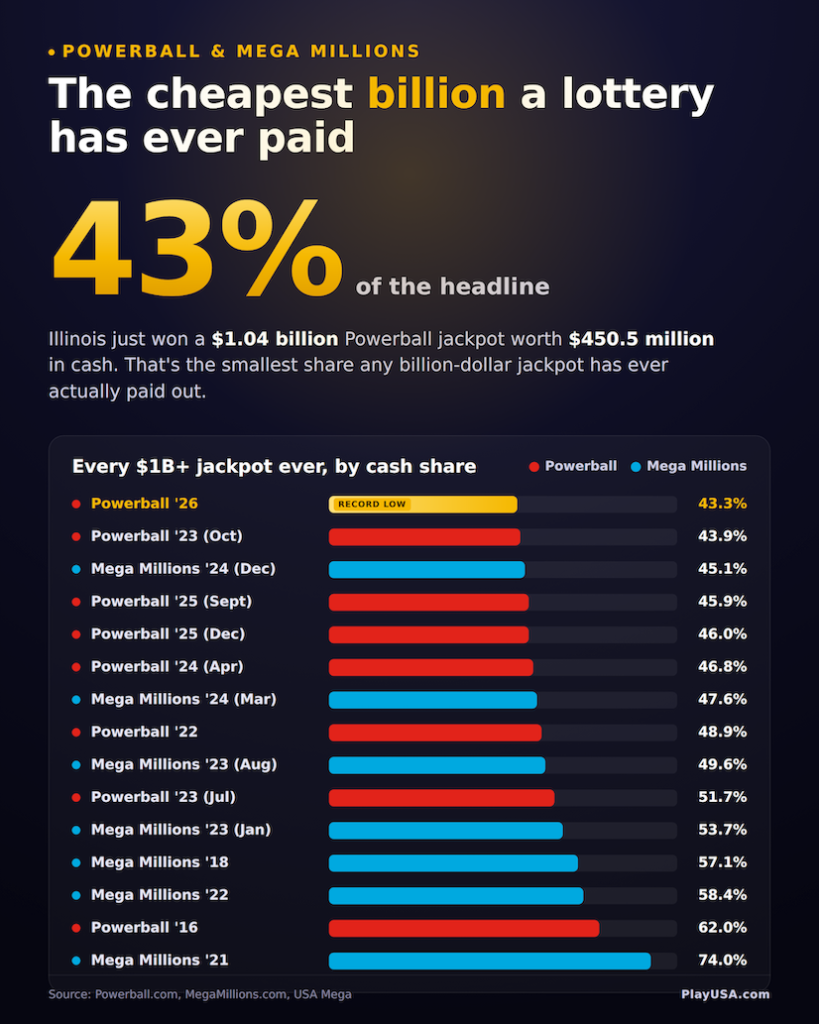
It was also the least valuable billion a lottery has ever advertised.
The cash value behind Wednesday’s jackpot was $450.5 million. That works out to 43.31% of the advertised prize. It is the smallest share of any billion-dollar jackpot ever offered by either Powerball or Mega Millions.
When Mega Millions last topped $1 billion during the era of near-zero interest rates, in January 2021, the winner in Michigan could take $776.6 million in cash against a $1.05 billion headline, or nearly 74 cents on the advertised dollar. Wednesday’s winner got 43.
Nothing about Powerball’s payout formula changed in between. The bond market did.
The billion-dollar club, ranked by what you actually get
Every time a US lottery jackpot has reached $1 billion, sorted by the cash option as a percentage of the advertised annuity:
| Game | Date | Advertised | Cash value | Cash share |
| Powerball | Aug. 12, 2026 | $1.040B | $450.5M | 43.31% |
| Powerball | Oct. 11, 2023 | $1.765B | $774.1M | 43.86% |
| Mega Millions | Dec. 27, 2024 | $1.269B | $571.9M | 45.07% |
| Powerball | Sept. 6, 2025* | $1.787B | $820.6M | 45.92% |
| Powerball | Dec. 24, 2025 | $1.817B | $834.9M | 45.95% |
| Powerball | April 6, 2024 | $1.326B | $621.0M | 46.83% |
| Mega Millions | March 26, 2024 | $1.128B | $537.5M | 47.65% |
| Powerball | Nov. 7, 2022 | $2.040B | $997.6M | 48.90% |
| Mega Millions | Aug. 8, 2023 | $1.602B | $794.2M | 49.58% |
| Powerball | July 19, 2023 | $1.080B | $558.1M | 51.68% |
| Mega Millions | Jan. 13, 2023 | $1.348B | $723.5M | 53.67% |
| Mega Millions | Oct. 23, 2018 | $1.537B | $877.8M | 57.11% |
| Mega Millions | July 29, 2022 | $1.337B | $780.5M | 58.38% |
| Powerball | Jan. 13, 2016 | $1.586B | $983.5M | 62.01% |
| Mega Millions | Jan. 22, 2021 | $1.050B | $776.6M | 73.96% |
*Split between Missouri and Texas; Powerball’s release cites the per-winner cash figure of $410.3 million.
The gap between the top and bottom of that list is 30 percentage points. Read it from the bottom up and it tracks one thing almost perfectly: the direction of long-term interest rates over the past decade.
Why the headline keeps outrunning the cash
The advertised jackpot is not a pile of money. The cash value is.
Ticket sales purchased via online lottery or retailers accumulate in a real prize pool, and Powerball’s stated definition of the cash value is the amount that has to be sitting in that pool on the day of the drawing to fund the advertised annuity. The headline number is then whatever 30-payment stream that pool can be made to buy. Causation runs backward from the cash, not forward from the billion.
If a winner elects the annuity, the Multi-State Lottery Association takes competitive bids from bond brokers and buys US Treasury securities: a ladder of zero-coupon instruments, one maturity for each payment year, each purchased at a discount today and maturing at the exact face value of that year’s check.
That is where rates come in, and Powerball’s own FAQ puts the relationship in a single sentence: “the higher the interest rates, the higher the advertised Grand Prize.”
Think of it as a mortgage in reverse. At high rates, a fixed monthly payment supports a much smaller loan. Here, a fixed pot of cash supports a much bigger advertised total, because a Treasury maturing in 2055 costs very little today when yields are high. When yields sat near zero in 2021, that same bond cost nearly its face value, so the cash pool and the advertised annuity nearly converged.
Run the discount rate implied in Wednesday’s numbers and the machine shows its work. Backing out the rate that makes 30 escalating payments cost exactly $450.5 million today produces 5.30%. The 30-year Treasury closed at 5.25% on Aug. 10. The implied rate inside a $1.04 billion lottery jackpot and the US long bond are within five basis points of each other.
Long yields have climbed all year. The 30-year started 2026 at 4.86% and hit its highest level since 2007 after the Federal Reserve held rates for the fifth straight meeting on July 29. The cash share had fallen in lockstep, from 45.95% on December’s $1.817 billion jackpot down toward 43.3% by the time this roll ended.
It had been essentially frozen there for the entire final stretch:
- Aug. 8: $864 million jackpot, $374.1 million cash
- Aug. 10: $929.1 million jackpot, $402.4 million cash
- Final rollover: $1.04 billion jackpot, $450.5 million cash
Those ratios sit within a few hundredths of a point of each other, which is why the record here belongs specifically to billion-dollar jackpots. No prize has ever been advertised at $1 billion while backed by so little cash.
Here is the whole relationship at a glance:
| Funding rate | Resulting cash share |
| 2.00% | 70.9% |
| 3.00% | 60.5% |
| 4.00% | 52.1% |
| 5.00% | 45.2% |
| 5.25% | 43.6% |
| 5.50% | 42.2% |
The top of that table is the 2010s. The bottom is now.
What $1.04 billion looks like spread over three decades
Powerball’s annuity is one immediate payment followed by 29 annual payments that each rise 5% over the last. That escalator is the second reason the headline flatters the prize.
For a $1.04 billion jackpot, the first payment works out to roughly $15.7 million, about 1.5% of the advertised number and only 45% of a simple 30th share. The final payment in 2055 would be about $64 million. A winner who took the annuity would not receive half the advertised total until payment No. 21, in 2046.
What Powerball winners actually take home
Take the $450.5 million cash, and the IRS withholds 24% immediately, or about $108.1 million. That is not the tax bill, though. It is a down payment. At 2026’s top federal rate of 37%, the full liability lands near $166.7 million, leaving roughly $58.6 million still owed at filing.
Net of federal tax alone: about $283.8 million, or 27 cents per advertised dollar. Then the states weigh in.
| Where the winner lives | Approximate net | Share of $1.04B headline |
| Florida, Texas, Tennessee, Washington, California* | $283.8M | 27.3% |
| Arizona (2.5%) | $272.6M | 26.2% |
| Maryland (9.5%) | $241.0M | 23.2% |
| New Jersey, DC (10.75%)** | $235.4M | 22.6% |
| New York City (10.9% + 3.876%) | $217.2M | 20.9% |
*California has a 13.3% top income tax rate but specifically exempts lottery winnings. State treatment turns on residency as well as where the ticket was bought.
**New Jersey withholds a tiered 5% to 8% at the point of payout. The 10.75% here is the top marginal rate a winner ultimately owes at filing, which is the figure used for the final net above.
A New York City winner keeps about 21 cents of every advertised dollar. Even in Florida, it is roughly 27.
One wrinkle worth noting: rising rates have quietly made the annuity the better mathematical deal than it has been in a decade. The break-even is that implied 5.3%, and it is guaranteed and Treasury-backed. Beating it after tax requires something like 7% to 8% pre-tax, depending on how gains are taxed.
In 2016, when the hurdle was under 3%, taking the cash was close to free money. It is a real decision now, though more than 90% of winners take the lump sum anyway, according to securities attorney Andrew Stoltmann.
How one Illinois ticket won $1.04 billion
The Aug. 10 numbers were 6, 37, 54, 55 and 64, with a Powerball of 10 and a 3x Power Play multiplier. Nobody hit the jackpot, extending the streak to 43 consecutive drawings without a winner since the last one fell on May 2, when tickets in Florida and Texas split a $20 million prize.
Wednesday’s numbers, the 44th drawing of that streak, were 4, 26, 66, 67 and 69, with a Powerball of 9 and a 2x Power Play multiplier. A single ticket sold at a Hy-Vee in Quincy, Illinois matched all six and ended it. A ticket in Florida also matched five numbers with Power Play for $1 million.
At $1.04 billion, Wednesday’s jackpot was the eighth-largest in Powerball history and the largest lottery prize of 2026. The record is the $2.04 billion won in California in November 2022. Two of the top four came in 2025 alone: $1.817 billion in Arkansas on Christmas Eve and $1.787 billion split between Missouri and Texas in September.
The most-drawn Powerball numbers
Since the current 69/26 matrix began on Oct. 7, 2015, across 1,395 drawings through Aug. 17, the white balls that have come up most often are:
| Number | Times drawn |
| 61 | 124 |
| 21 | 123 |
| 64 | 122 |
| 28 | 119 |
| 27 | 118 |
| 36 | 117 |
The most frequent Powerballs are 4 (66 times), 14 (65) and 21 (63). The coldest white ball is 13, at 75 appearances; the coldest Powerball is 16, at 40.
Monday’s draw actually leaned hot: 64 is the third most-drawn white ball in the matrix’s history.
None of it means anything, and it is worth saying plainly. Each white ball should appear about 101 times by chance, with a standard deviation near 10. The hottest number is 2.4 standard deviations above expectation and the coldest 2.7 below, which across 69 balls is exactly the spread that randomness produces. There is no evidence of bias in the ball sets.
What can actually change your payout is who else picked your numbers. Research on lottery number preference consistently finds players cluster on low digits and calendar dates, meaning combinations above 31 are systematically underplayed and less likely to be shared.
The best illustration remains March 30, 2005, when 110 players matched all five white balls in a single drawing. Every one of them played 22, 28, 32, 33 and 39, the numbers printed inside Wonton Food’s fortune cookies. They missed the jackpot only because the cookie’s sixth number was 40 and the Powerball was 42.
Somewhere between 70% and 80% of tickets are quick picks, and the same share of winners are quick picks. The win rate simply mirrors the sales rate.
Where and how to buy a Powerball ticket
Powerball is sold in 45 states, Washington DC, Puerto Rico, the US Virgin Islands and the United Kingdom (since July 21). Tickets are $2 in the US, plus $1 for Power Play. Drawings happen Monday, Wednesday and Saturday nights at 10:59 p.m. EDT.
Online through official state lotteries. Roughly a dozen jurisdictions sell Powerball directly through their own website or app, including Georgia, Illinois, Kentucky, Michigan, New Hampshire, North Carolina, Pennsylvania, Virginia, West Virginia, Connecticut, Tennessee and DC. Massachusetts joined on July 27, with an unusual split age rule: 21 and up to play online, but 18 at retail. Maryland, New York and North Dakota offer subscriptions rather than single online tickets.
Every one of these requires you to be physically inside the state when you buy, verified by geolocation. You do not generally need to be a resident.
Online lottery tickets can be bought via couriers on your behalf at a licensed retailer and store it in a vault. Only New Jersey and New York license and regulate them; most other states where they operate have no statute either way.
| Courier | Jurisdictions | Licensed and regulated in |
| Jackpocket | 17 | New Jersey and New York only |
| Lotto.com | 12 | New Jersey and New York only |
| Jackpot.com | 7 | New Jersey and New York only |
Several states have shut the door. Wisconsin bans courier services outright by statute and allows ticket sales only for cash. California’s lottery told retailers in 2024 that couriers are illegal and that it will not pay prizes on courier-bought tickets. Indiana banned them in 2025, Mississippi’s attorney general found them unauthorized, and Florida shut down TheLotter’s service.
Texas went furthest. After a courier-placed $83.5 million Lotto Texas win in early 2025, the state prohibited couriers, abolished the 32-year-old Texas Lottery Commission, and moved the game under the Department of Licensing and Regulation. Online or courier ticket sales are now a Class A misdemeanor. Selling more than 100 tickets to one buyer in a single transaction is a separate, lesser Class B misdemeanor. A Texan buying a ticket has to do it in person, and not more than 100 at a time.
Cutoff times close earlier than you think, all well ahead of the 10:59 p.m. EDT draw:
| State | Cutoff time | Eastern equivalent |
| Washington | 6:45 p.m. PDT | 9:45 p.m. EDT |
| California | 7:00 p.m. PDT | 10:00 p.m. EDT |
| Colorado | 7:30 p.m. MDT | 9:30 p.m. EDT |
| Texas | 9:00 p.m. CDT | 10:00 p.m. EDT |
| Florida | 10:00 p.m. EDT | 10:00 p.m. EDT |
Courier apps close their windows earlier still.
| Where | Minimum age |
| Most states | 18 |
| Nebraska | 19 |
| Arizona, Iowa, Louisiana, Mississippi | 21 |
How UK players get a different Powerball
In the UK. British players buy through the National Lottery website, app or an authorized retailer at £4 per line, with entries closing at 11:55 p.m. UK time. The draw lands around 4 a.m. Thursday there.
The UK game shares only the jackpot; every lower tier pays a fixed sterling prize funded separately, including a £1 million payout for matching five and an £8 tier for matching two that has no US equivalent. That extra tier improves overall odds of winning something to about 1 in 14, against 1 in 24.9 in the US.
Jackpot odds are identical at 1 in 292.2 million.
Two differences matter for anyone comparing headlines. UK winners have no lump-sum option at all. The prize is paid as a 30-year rising annuity.
And the UK figure is not a straight currency conversion of the US gross annuity. The National Lottery applies an effective top tax rate to the shared pool before converting what’s left to sterling, even though UK winners themselves owe no tax on the prize. That is why the same jackpot that showed $1.04 billion in America was advertised in Britain as £542.9 million, a new UK record that ran in headlines there simply as “£500 million.”
The prize itself is not taxed by HMRC. UK lottery winnings are treated as a windfall, free of income and capital gains tax, so the gap between the two headlines is a pre-tax-versus-post-tax effect as much as a currency one, not a British one.
One caution for British players searching for the game: several lookalike sites advertise a “UK Powerball” with different prices and draw times. The only legitimate routes are the National Lottery website, its app and authorized National Lottery retailers.
Wednesday’s winner won’t wait long for a successor. The jackpot reset to $21.7 million by Saturday, climbed to $34.2 million with no winner Monday, and is estimated at $48 million, cash value $20.8 million, for tonight’s drawing. Same 43% ratio. Much smaller number.