



 Share
Share 



Prediction markets have been volatile this week, characterized by a mix of slow fades, quiet rotations, and a few markets finally breaking out after months of stagnation. Some trades, such as tariff stimulus checks, have lost nearly all momentum and are drifting toward zero. Conversely, the 2028 Republican nominee race is tightening as new contenders gain traction.
Simultaneously, more reactive markets—such as those for Donald Trump’s next attorney general—have seen sharp shifts in sentiment, illustrating how quickly pricing can flip when narratives change.
On the other hand, longer-term and macro-style markets are starting to take shape. The race for the Men’s World Cup winner is tightening at the top following major injury news, and the IPO market continues to balance real-world fundamentals with speculation, particularly regarding crypto and AI companies. It is a mix of consolidation and quiet repositioning, with momentum building in several key areas.
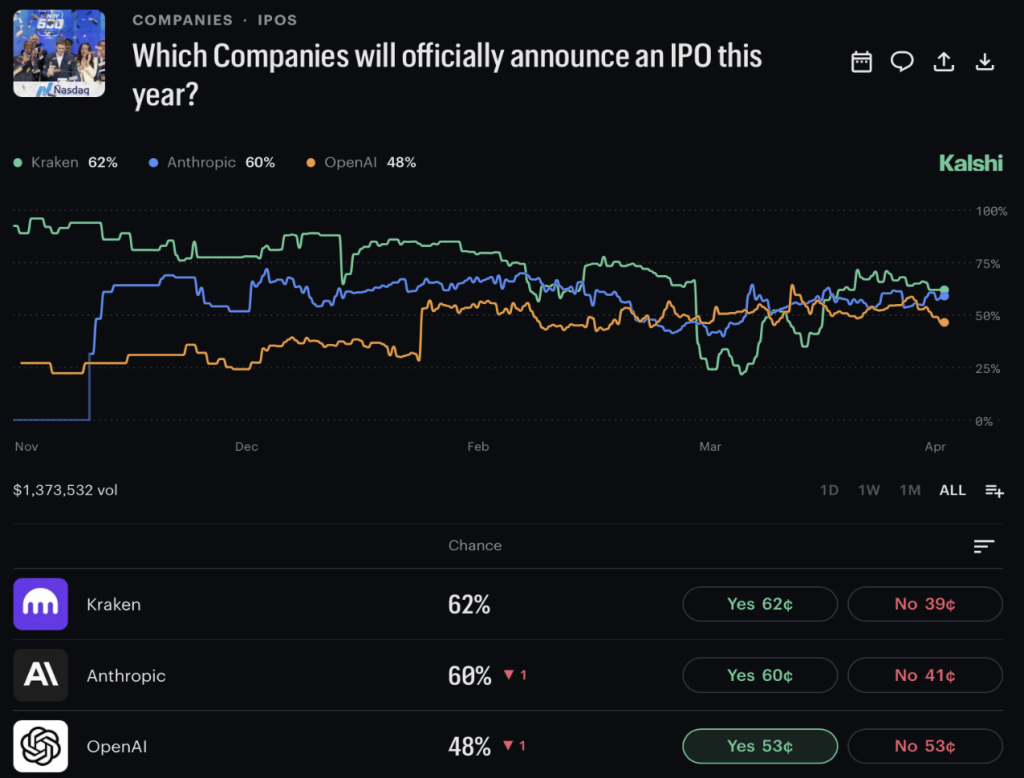
Momentum collapses for tariff stimulus markets
This market experienced a significant surge early on but has steadily faded since. In November, a sharp spike occurred across all timelines, with the “Before 2027” contract pushing close to 60%. There was a clear belief that tariff-related stimulus could materialize, but that momentum was short-lived.
Since then, it has been a consistent downward grind. Current pricing sits at just 3.3% for “before July,” 5% for “before August,” and 13% for “before 2027.” Every bounce over the past few months has been sold off; the trend across all contracts reflects lower highs and lower lows.
The most notable factor now is the lack of volatility. The market is no longer reacting significantly, suggesting traders have settled on the idea that these checks are unlikely to be issued soon. Even the longer-term contract sitting in the low teens suggests a general lack of confidence rather than a simple delay. At this point, it appears more like a long-shot hold than an active trade.
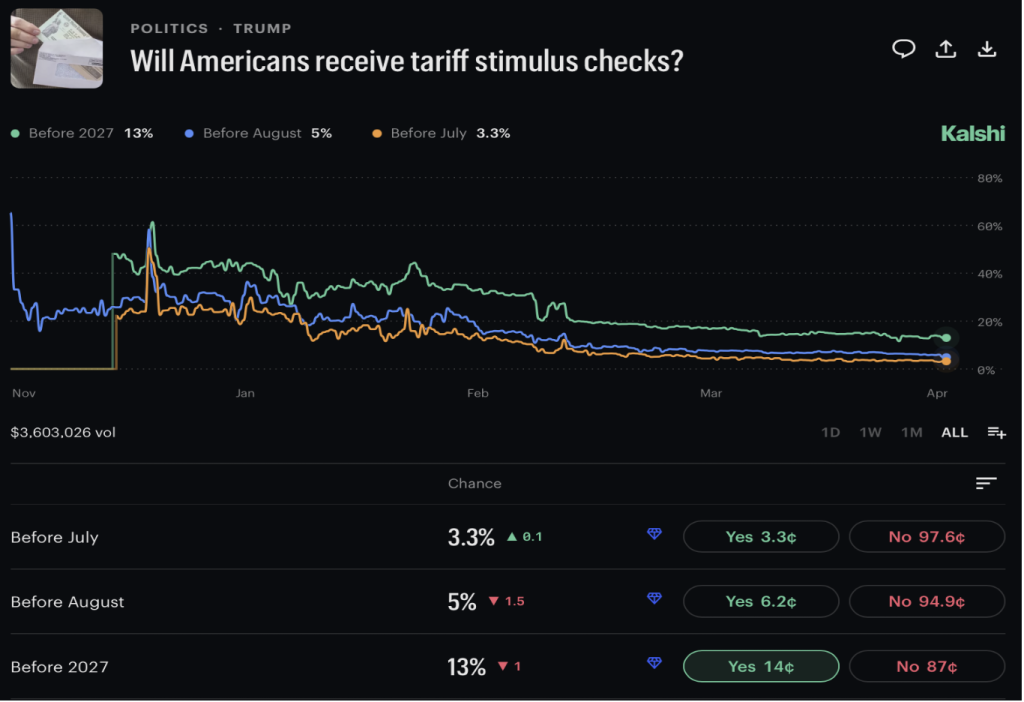
2028 republican presidential nominee tracker
This market has shifted quietly over time, but the trend is clear when viewed broadly. Vice President J.D. Vance has held the lead for most of the timeline, though his path hasn’t been linear. He peaked in the mid-50s last year before slowly bleeding down to his current 39%.
Meanwhile, Sen. Marco Rubio has moved in the opposite direction. Starting in the low single digits, he has steadily climbed to 25%, with a noticeable acceleration over the past few months. This “grind up” suggests consistent buying rather than one-off reactions to news cycles.
Tucker Carlson remains the outlier. Initially absent from the market, he popped up and climbed into the high single digits but has failed to push further. At 7.3%, he currently represents a speculative play rather than a primary contender. The compression at the top suggests the race is no longer a runaway for Vance but a slow rebalancing.
Cabinet odds: Trump’s next AG frontrunner
This market has been more volatile than most, particularly over the past few weeks. Early on, Lee Zeldin held a strong lead, sitting well above 50% before gradually ceding that position as the month progressed.
The primary shift occurred in mid-April when Todd Blanche began to gain significant traction. Blanche eventually flipped Zeldin and pushed into the high-50s, currently holding at 57%. Such a move usually signals sustained buying rather than market noise.
Concurrently, Zeldin has trended downward. After holding the top spot early, he has fallen to 26%, and the decline has yet to find a floor. Florida Gov. Ron DeSantis has seen brief spikes, but none have held; at 6%, he is currently viewed as a reactive trade. For now, this appears to be Blanche’s market to lose.

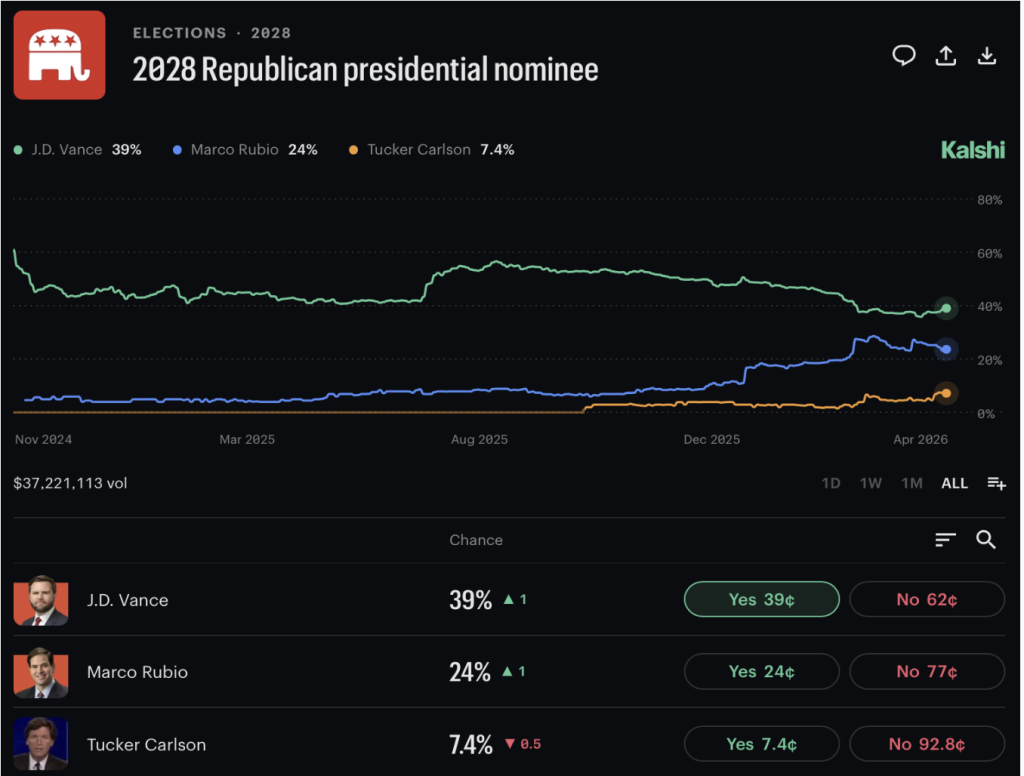
World Cup betting: France eclipses Spain
While this market remained stable for most of the year, things have tightened significantly following news from the pitch. Spain held a slight edge for months, but that lead has effectively vanished following the recent hamstring injury to star winger Lamine Yamal, which has cast doubt on his availability for the summer tournament.
France is the notable mover, capitalizing on Spain’s uncertainty. After plateauing in the 11% to 13% range, France recently jumped to 18.8%, officially overtaking Spain. This was a clean breakout, signaling a genuine shift in sentiment. Spain, meanwhile, has stalled at 16.7%. While they have held their ground, they have been unable to push higher while France moved.
England remains at 11.5% but lacks similar momentum. Currently, the market reflects a two-team race with the gap between France and Spain nearly nonexistent as we head into the tournament window.
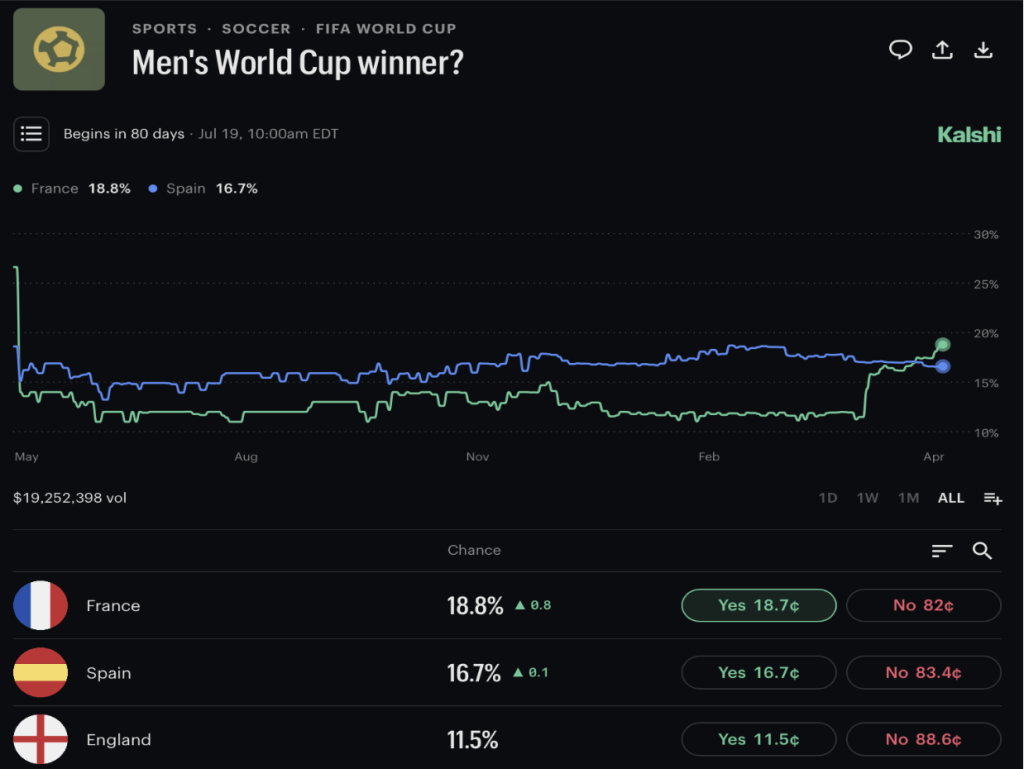
IPO watch: Kraken, Anthropic, OpenAI
This market has evolved into a tight three-way race, with pricing reflecting a blend of fundamentals and hype. Kraken leads at 62%, followed closely by Anthropic at 60%, while OpenAI sits at 48% following a volatile run.
Kraken’s position is structurally sound, particularly after securing a Federal Reserve master account in March. As an established crypto exchange with a pending S-1, it appears “IPO-ready” compared to its peers. Despite a sharp dip in March following the BitGo decline, Kraken recovered well, suggesting traders view it as the most likely near-term candidate.
Anthropic’s 60% valuation has been reached through a gradual, consistent bid—a sign of steady confidence. While the AI sector attracts massive investment, most firms remain focused on private funding. OpenAI, despite being the most prominent name, remains the hardest to price. At 48%, it is essentially a coin flip, as traders weigh its $840 billion post-money valuation against the lack of a formal underwriting mandate for 2026.