



 Share
Share 



Pennsylvania wants to ask for help to come with fewer strings attached as it expands its state-level responsible gambling initiatives.
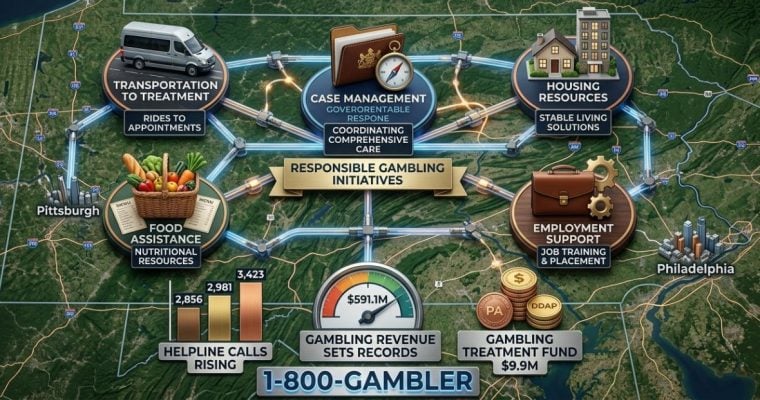
The state Department of Drug and Alcohol Programs is adding case management services to its problem gambling network, a shift from therapy alone toward something more practical.
For the person who can make it to a counselor but can’t find a ride to get there. Who wants treatment but can’t leave the kids to go get it. Who needs a job, or a place to sleep, before recovery even has a fair shot.
Case managers now connect people to transportation to treatment, food assistance, housing resources and referrals to free or low-cost community programs, on top of standard counseling. Roughly 15 organizations across the Commonwealth are already providing the services, according to the department.
“This is a landmark day for problem gambling services here in Pennsylvania,” said Dr. Latika Davis-Jones, DDAP’s secretary. She said the department kept hearing the same thing from people already in treatment: too much of their counseling time was going to everything gambling had cost them — a place to live, a way to get around — before they could even get to the gambling itself.
“By offering case management, we will help bridge the gap between treatment and outside factors that can affect someone’s ability to recover by providing a consistent point of support to help navigate available resources and barriers to care.”
Why Pennsylvania’s problem gambling helpline is busier
The expansion follows a real climb in demand, not just a hunch. Pennsylvania’s problem gambling helpline logged 3,423 calls, texts and online chats combined in the state fiscal year that ended last June, up from 2,856 the year before, according to DDAP’s most recent annual report. That’s a jump of nearly 20%.
Treatment admissions rose even faster, up 24% year over year to 289. The state’s gambling treatment fund took in more than $9.9 million in statutory transfers over that same stretch, with $617,628 of it spent directly on treatment, up only slightly from $616,059 the year before.
That growth is unfolding against a gambling market still setting records. The Pennsylvania Gaming Control Board reported $591.1 million in combined gaming revenue for July, up 5.99% from a year earlier. Sports bettors alone put $509.5 million into the state’s books that month, a handle up 23.53% year over year, with sportsbooks keeping $51.8 million of it as taxable revenue.
Josh Ercole, executive director of the Council on Compulsive Gambling of Pennsylvania, said the new services reach further than most people assume gambling addiction touches.
“When people think of gambling problems, money is often the first thing that comes to mind,” Ercole said. “While financial problems often exist, many other areas of life can also be impacted, requiring a wide range of resources. Having case management services available for problem gambling will help to better address the specific needs of individuals and families across the Commonwealth.”
Elizabeth Ward, clinical manager at Penn State Health’s Advancement in Recovery Program, put it more plainly.
“Case management is often the first step toward recovery,” Ward said. “By connecting individuals with essential resources such as housing, transportation, food assistance, and employment support, we help create the stability they need to focus on healing and moving forward with their lives.”
How to reach help in Pennsylvania
Pennsylvania’s problem gambling helpline runs free and confidential, 24 hours a day, by phone, text or online chat. Bet with your head, not over it. Call 1-800-GAMBLER if you have a gambling problem.
David Yeager is in long-term recovery from a gambling disorder. He said the new case managers give people somewhere to start when they don’t know where else to turn.
“People who feel like they don’t have hope, where they don’t know where to go, can now sit in front of somebody who can not only begin to understand the problems with gambling but the problems that are associated with it,” Yeager said. “This is an incredible program.”
Operators are moving too. FanDuel and Kindbridge Behavioral Health said this week that they are expanding a responsible gambling partnership focused on prevention, self-assessment and access to professional support.
Davis-Jones already said what the expansion is really for.
“Asking for help is not a sign of weakness. It is an act of courage.”