






 Share
Share 



Prediction markets — platforms where traders buy and sell contracts tied to the likelihood of real-world events — are drawing increasing attention from everyday users, institutional investors and mainstream media alike. Transparent, market-driven pricing and an expanding range of contracts have helped propel the sector beyond niche use, making topics from the Super Bowl to presidential impeachment trending in markets such as Kalshi.
1. Who will win the Super Bowl?
Trade on Sports, Politics, and MORE
Largest Prediction Market in the US
Hundreds of Markets to Choose From
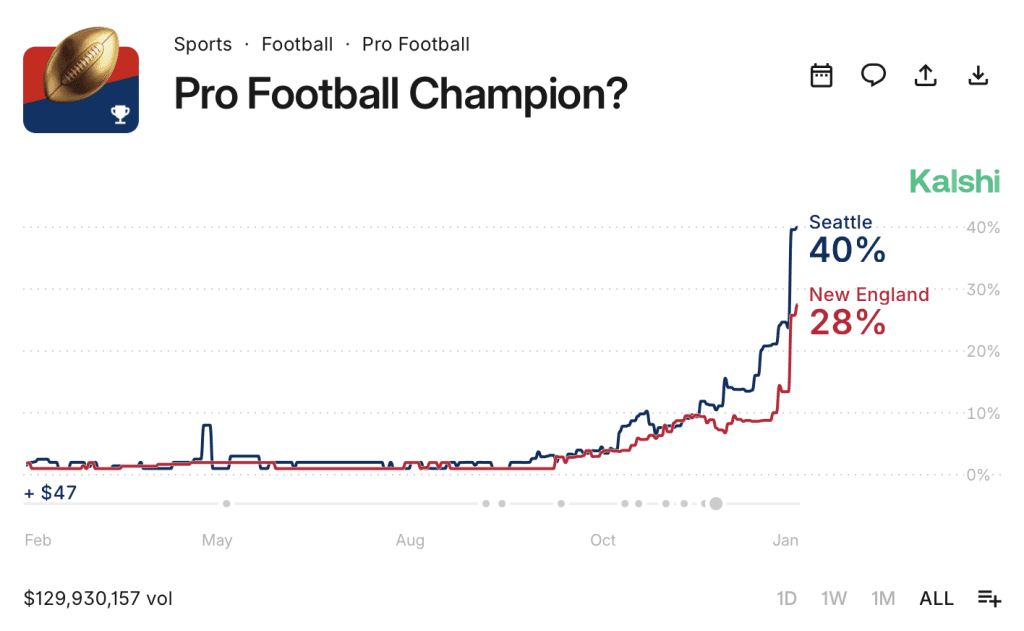
After a wild NFL weekend that saw the Seattle Seahawks, New England Patriots, Los Angeles Rams and Denver Broncos survive their divisional playoff games, the prediction market for the Super Bowl winner is leaning heavily toward Seattle.
The Seahawks have a 40% chance of winning the big game based on “yes” contracts, while the Patriots and Rams are hovering around 28%. The Broncos trail far behind at 7%.
Seattle, New England and Denver finished the season with an NFL-best 14-3 record, while the Rams entered the playoffs at 12-5. On paper, the Seahawks have been the strongest team in the postseason, scoring 54 points while surrendering just nine. The contract market has little faith in the Broncos, who lost starting quarterback Bo Nix to a broken ankle late in Denver’s overtime win against the Buffalo Bills.
2. Will credit card rates be capped this year?
Earlier this month, President Donald Trump said he wants to cap credit card interest rates at 10% for one year, a move that could save consumers with large balances thousands of dollars over 12 months. The announcement drew backlash from the credit card industry, as interest payments generate tens of millions of dollars in revenue for banks and card issuers.
Trump’s most viable option would be to push Congress to pass legislation implementing the cap, as attempting to pressure banks through an executive order would likely be tied up in lawsuits.
Kalshi’s prediction market is pessimistic, giving the rate cap a 30.9% chance of happening.
3. Will Trump be impeached?
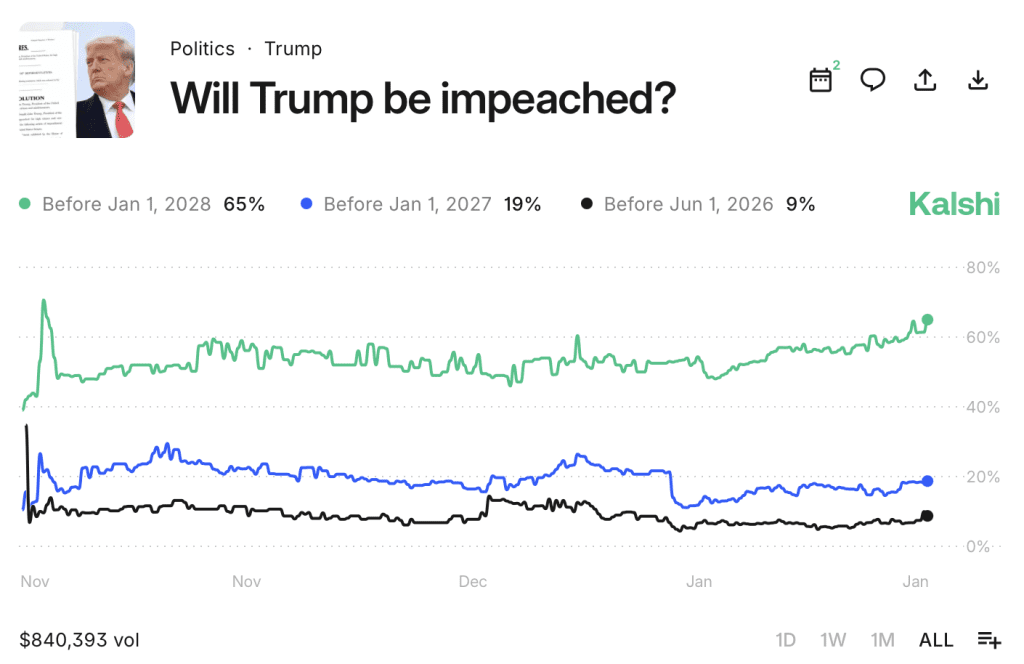
Earlier this month, Rep. Don Bacon said he would raise impeachment if President Trump attempted to invade Greenland — a notable statement considering Bacon is a Republican.
“It’s ridiculous that this has to even be discussed,” Bacon said in an interview with the Omaha World-Herald last week. “But when the president talks about taking Greenland one way or another every day for the past week or so, and says it would be unacceptable if Greenland refuses to be part of the United States, I felt like I needed to make a statement that Republicans disagree.”
Trump has been impeached twice: once for his involvement in foreign interference in the 2020 presidential election, and once for his role in the Jan. 6 insurrection.
4. Who will Trump nominate as Fed chair?
Federal Reserve Chair Jerome Powell’s term will end in May 2026. The vacancy will be filled by a Trump appointee, and the prediction market is currently split between Kevin Hassett, director of the National Economic Council, and Kevin Warsh, a former member of the Federal Reserve Board of Governors.
Warsh is the market favorite at 59%, while Hassett has a 16% chance of being appointed.
5. Will Trump buy at least part of Greenland?
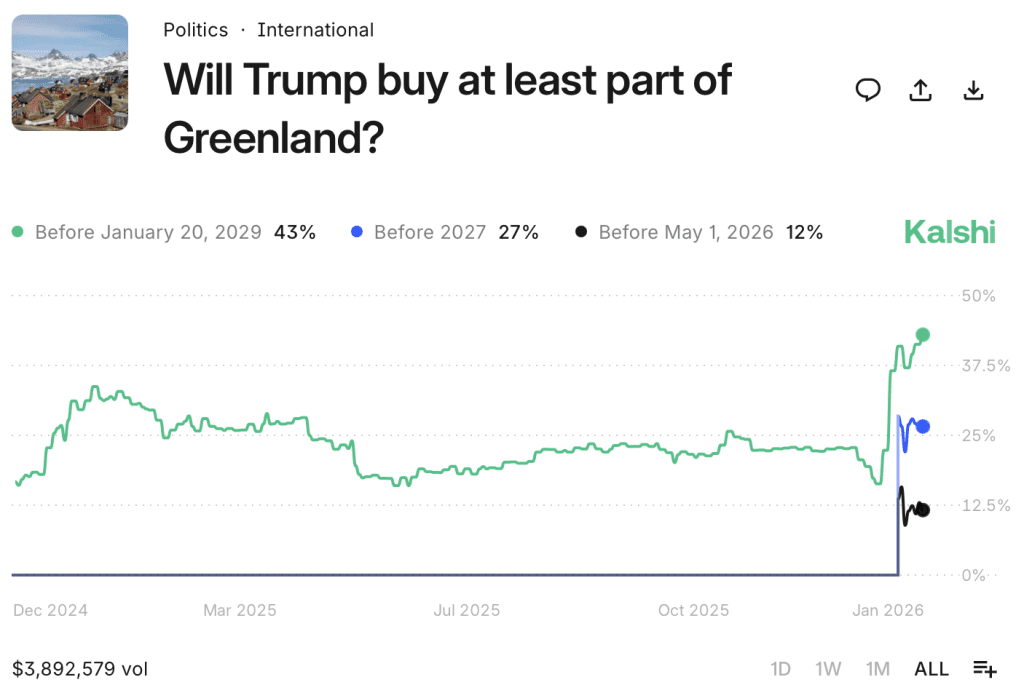
In one of the stranger ongoing news threads of the past 13 months, President Donald Trump has repeatedly said he wants Greenland to become part of the United States. Talk of annexation died down for a time but has resurfaced in recent weeks.
While Trump may be floating the idea of purchasing the frigid island territory, the prediction market is skeptical. Kalshi places the odds of Trump buying at least part of Greenland at 43% before his term ends, and 27% before 2027.
Why traders—and the public—are paying closer attention
Prediction markets are growing quickly for several reasons. They offer real-time probability estimates that update as new information arrives, often outperforming traditional polls and static forecasts. They also now cover a broader array of events — from economics to entertainment — and are easier to access than ever due to enhanced interfaces and clearer contract design. Increased regulatory legitimacy and participation from institutional players have further boosted liquidity and user confidence.
Activity is rising not just around US events but global ones such as major elections in Colombia, Costa Rica and Sweden, where traders are using contracts to price geopolitical risk and shifting world trends.
Mainstream media, including financial news outlets, increasingly incorporate prediction market odds into their reporting, further expanding public awareness and engagement. All told, prediction markets are moving from fringe forecasting tools to widely used indicators of probability and sentiment — reshaping how both casual traders and professional analysts track future events.


