


 Share
Share 



Most sweepstakes casinos operate on the same dual-currency model. Players get two kinds of coins: one that’s free to earn and worthless outside the game, and one that can be redeemed for cash. No purchase is necessary to get either kind. Buying a coin package just gets you there faster.
Courts have heard the argument behind that model many times. The first was in 1852.
That’s the year New York’s highest court decided a case about an art lottery. It ruled that a prize doesn’t even need to be cash for a game to be a scheme, and it rejected the idea that a good cause excuses it.
The sweepstakes casino industry’s core legal position – the one behind the dual-currency model running Chumba, LuckyLand, Global Poker, and every other Gold Coin/Sweeps Coin operator selling promotional currency right now – is 174 years old.
Nothing about the argument has changed. What has changed is what it’s attached to.
An art club learned this first
In 1851, a New York charity called the American Art Union sold $5 memberships that came with something extra: one chance in an annual drawing for the paintings the club had purchased that year. Pay $5, get a number, and maybe walk away with an art piece worth $100.
The city’s poor-relief board sued, arguing that it was a lottery, no different from selling numbered tickets for a cash prize, and that state law banned it.
The Art Union’s defense was one the industry still uses. The prizes weren’t cash; they were paintings. The purpose wasn’t profit; it was promoting American art. Surely that made a difference.
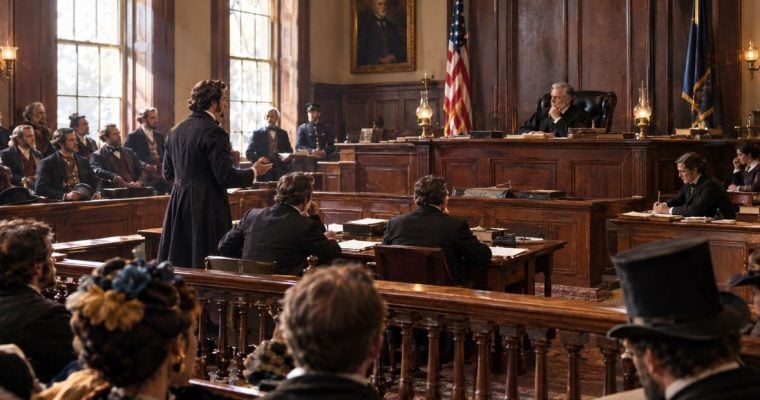
It didn’t. The Court of Appeals, with Chief Justice Ruggles writing for the majority, laid out the rule that still governs this fight.
“Payment of the prizes in money is not one of the essential ingredients of a lottery. Wherever the scheme of distribution is such, that if the payment of the prizes were in money, it would be a lottery, it will be equally so, although the prizes are payable in lands or in chattels.”
Cash doesn’t matter. Chance and consideration do.
The court didn’t buy the charity angle either.
“The promotion of the fine arts is undoubtedly a commendable object, but the prohibition contains no exception in its favor on that ground. If it were to be admitted, that the scheme is entirely harmless in its consequences, it would form no ground for making it, by judicial construction, an exception to the general and absolute constitutional prohibition.”
Judge Edmonds dissented. The ruling stood, and it’s still the earliest fully documented version of the exact question a state attorney general asks about sweepstakes casinos today.
The definition that’s still in use
A New York court returned to the same question in the mid-1870s, this time over a retail gimmick. A seller packed goods so that some packages secretly held a ticket redeemable for something more valuable. It was a 19th century gift enterprise, mechanically closer to a modern promotional sweepstakes than a straight lottery ticket ever was.
The court, in Hull v. Ruggles, ruled the underlying sale itself void, since the seller had knowingly supplied the mechanism for an illegal scheme.
That’s the origin of the three-part test regulators still apply:
- A pecuniary consideration is paid.
- Chance decides the outcome.
- A scheme held out to the public determines what the payer gets for it.
Buy the coins; chance decides what you win and the operator sets the terms in advance. It’s the same scheme, now run on a phone and a dual-currency wallet instead of a shelf of packaged goods.
New York’s top court applied that same reasoning again in 1878, this time to a numbers bet on a Kentucky lottery drawing. The court dropped a line that reads like it was written for every clever workaround since:
“The office of the judge is to make such construction as will suppress the mischief and advance the remedy, and to suppress all evasions for the continuance of the mischief.”
A hundred and forty-eight years later, that’s still the sentence a court reaches for whenever an operator argues its way around a definition instead of around the conduct.
Congress got involved next. The federal ban on mailing lottery tickets, still on the books as 18 U.S.C. Section 1302, traces to 1909. A ban on broadcasting lottery information followed in the original Communications Act of 1934, later folded into the same federal criminal code. Both statutes are older than Social Security.
Movie theaters found a loophole
The clearest pre-internet version of the sweepstakes casino defense wasn’t a court case at all. It was a theater promotion called Bank Night.
Charles U. Yaeger, a Denver theater booker, invented Bank Night in 1931. Patrons registered their names in a book for a shot at a cash prize, drawn at random during the show, and it cost nothing to enter. No ticket purchase, no admission fee required for a chance to win.
It was a lottery with the purchase requirement removed on purpose, built specifically to survive the same restrictions the American Art Union ran into 80 years earlier. And it worked well enough to spread fast. By 1936, it ran in roughly 5,000 of the country’s 15,000 movie theaters. One in three American movie screens was quietly running a lottery workaround during the Depression.
States split on whether the workaround was actually legal. Montana’s attorney general called it an illegal lottery in 1941. Eight years later, West Virginia’s Supreme Court upheld a nearly identical giveaway as legal. A law review survey of the era found the same divide play out across the country.
Where Bank Night stood, state by state
| RULING | STATES |
|---|---|
| Upheld as legal, on some theory of technical or non-monetary consideration | Alabama, California, Delaware, Florida, Illinois, Kentucky, Massachusetts, Michigan, Missouri, New Jersey, Vermont |
| Struck down, on a requirement of real valuable consideration | Iowa, Montana, New Hampshire, New York |
California shows up on both sides of that count across the historical record, which the source material treats as an unresolved split in the state’s own case law over time rather than a clean error. Worth noting rather than flattening into one answer.
Eleven states looked at a free lottery attached to a paid business and called it legal. Four looked at the same mechanism and banned it. Nothing about the scheme changed from state to state. The consideration test just got applied differently, which is the same reason a sweepstakes casino operates in most of the country today and is a felony in Louisiana.
The rule that briefly policed the gimmick … then quietly died
The federal government’s one real intervention against dressed-up lotteries came from an unexpected direction.
In 1969, the Federal Trade Commission wrote a rule, 16 CFR 419, aimed at a specific supermarket and gas station scam. Promoters were seeding big-prize game pieces into certain stores or certain weeks instead of distributing them randomly, running dummy game boxes with no real winners at all, and advertising odds as long as 1 in 7 million while burying that fact under the size of the top prize.
The rule required exact prize counts, real odds, and the geographic scope of a promotion to be disclosed, and banned rigging the distribution.
It worked well enough that it stopped mattering. The FTC repealed the rule in 1996, 27 years after it took effect, after finding zero enforcement actions had ever been brought under it and that retail practices had moved past the exact scam it targeted.
A federal disclosure rule for sweepstakes existed, then went unused for nearly three decades, then vanished, and nothing has replaced it since.
VGW was founded in 2010 in Perth, Australia. In 2012, it launched Chumba Casino, the product that popularized the modern dual-currency format at scale.
Between the old model and the new one sits a quieter middle step: internet sweepstakes cafes. They were storefronts that ran sweepstakes-based slot terminals through the 2000s and into the early 2010s before state crackdowns pushed the same legal structure online.
Fourteen years after Chumba’s launch, and a century and a half after Hull v. Ruggles, the legal question is exactly the one it has always been. Only the delivery mechanism has changed, from a movie ticket book to a storefront terminal to an app.
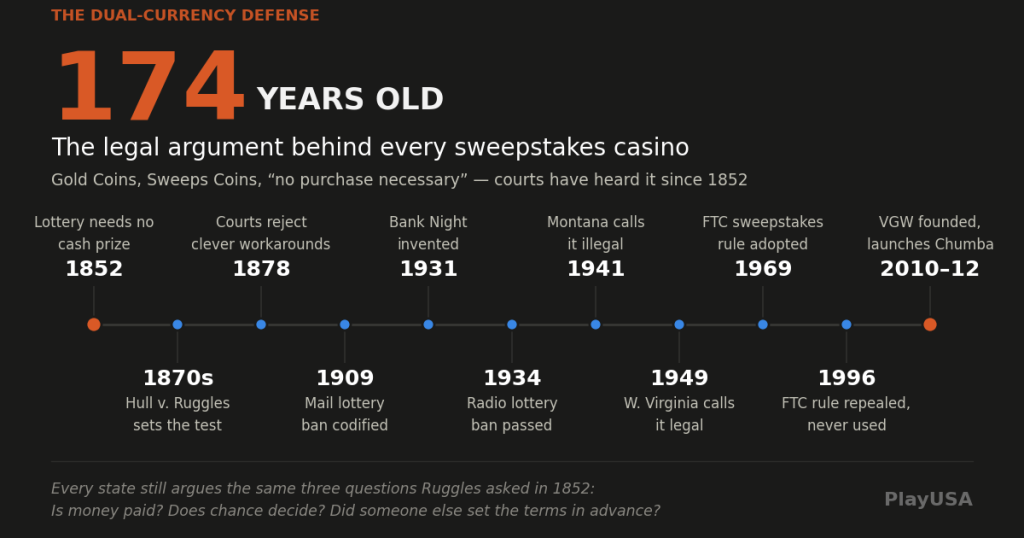
The paper trail
| YEAR | ACTION | YEARS AGO |
|---|---|---|
| 1852 | New York's top court rules a lottery needs no cash prize, and good intentions are not a defense | 174 |
| Mid-1870s | New York's top court voids a retail gift-enterprise scheme and sets the three-part test still used today | About 150 |
| 1878 | New York's top court rules that judges exist to suppress evasions of gambling law, not bless clever ones | 148 |
| 1909 | Congress bans mailing lottery tickets, codified as 18 U.S.C. Section 1302 | 117 |
| 1931 | Charles U. Yaeger invents Bank Night in Denver, a free prize drawing designed to dodge lottery law | 95 |
| 1934 | The original Communications Act bans broadcasting lottery information | 92 |
| 1941 | Montana's attorney general calls Bank Night an illegal lottery | 85 |
| 1949 | West Virginia's top court upholds a nearly identical giveaway as legal | 77 |
| 1969 | The FTC adopts a federal sweepstakes disclosure rule | 57 |
| 1996 | The FTC repeals that rule after 27 years with zero enforcement actions | 30 |
| 2010-2012 | VGW is founded, then launches Chumba Casino | 14-16 |
The myth about a 2006 loophole
Ask why the dual-currency model exists online at all, and one explanation comes up constantly: A 2006 federal law, the Unlawful Internet Gambling Enforcement Act, supposedly carved out the exception that let sweepstakes casinos move onto the internet.
It didn’t.
The law’s own list of exceptions covers fantasy sports, skill-based games, and a handful of narrow financial and in-state gambling categories. Sweepstakes never show up in it. Not once.
That’s worth setting straight because the real explanation is better than a phantom loophole. Sweepstakes casinos never needed a federal exception. They rest on the same state-level lottery and consideration doctrine that’s been on the books since 1852, the one Hull v. Ruggles refined and Wilkinson v. Gill enforced.
The 2006 law targeted payment processing tied to gambling that’s already illegal under state or federal law. Sweepstakes operators’ entire legal position is that their product was never gambling to begin with, arguing that that law doesn’t apply.
The industry didn’t slip through a new federal door in 2006. It walked through a state-law door that had been standing open, and occasionally slammed shut, since before the telephone.
A second myth is easier to knock down. One version of this history claims a federal postal ruling in 1934 banned sweepstakes contests outright.
No such ruling exists.
The real 1934 law banned broadcasting lottery information over the radio, under the original Communications Act, which has nothing to do with the mail and nothing to do with sweepstakes specifically.
The industry’s own trade group makes essentially the same historical argument the American Art Union made in 1851, just aimed at a different comparison. Matt Kaufman of the Social and Promotional Games Association put it this way in comments carried by Legal Sports Report:
Buying a coin package for a chance at a prize is no different from a fast-food chain running a promotion where buying a burger comes with a chance at cash.
It’s the same defense on a new label. No purchase necessary, a chance to win, and a business built around the sales the sweepstakes drives — which is precisely the structure the Court of Appeals looked at in 1852 and decided it didn’t matter what you called it.
What the history actually says about today’s fight
Nine states have banned sweepstakes casinos outright as of September 2026:
- California
- Connecticut
- Indiana
- Louisiana
- Maine
- Montana
- New Jersey
- New York
- and Tennessee
Oklahoma is set to become the 10th when its ban takes effect Nov. 1. More states are weighing bills.
What history says about the sweeps fight is that it was never going to have a clean, unanimous outcome. Bank Night didn’t. Eleven states blessed it. Four states killed it. The same split is playing out now, a near century later, with sweepstakes casinos in place of movie tickets.
History also says the workaround that eventually wins isn’t necessarily the cleverest one. It’s the one that survives long enough, and quietly enough, that regulators stop treating it as urgent.
The FTC’s 1969 rule didn’t get repealed because sweepstakes got safer. It got repealed because nobody was enforcing it, on anything, for 27 years.
What this means if you’re holding Gold Coins right now
No purchase necessary is not a courtesy. It’s the legal load-bearing wall the entire dual-currency model stands on, and it has been since before the Civil War.
A legitimate sweepstakes casino has to offer a free path to Sweeps Coins, typically a mail-in request, and has to make that path genuinely usable, not buried three menus deep. If an operator makes the free entry difficult to find or use, that’s the exact defect that has sunk this defense in court going back to 1852.
Minimum ages vary by operator. Some run 18 and older, some run 21 and older. Check the specific site before assuming either.
Check your state’s current status before playing anywhere. A product that’s fine in one state can be a felony in the next one over. And the industry’s legal argument, however old, does not travel across state lines.
Read the redemption terms before buying a coin package, not after. The three-part legal test that’s been in use since the 1870s – a payment, a chance, a scheme that decides the payout – means the terms of that scheme are the entire legal ballgame.
If the redemption threshold, the identity verification requirement or the free-entry method aren’t stated plainly before money changes hands, that’s not a customer service gap. It’s the same weakness a court has been able to find in this exact model since Hull v. Ruggles.
The lawyers changed. The pitch got a splash screen and a slot reel. The question a New York judge asked in 1852 — whether a person pays something, chance decides the outcome, and somebody else already fixed the terms — is still the only one that’s ever mattered here.
Everything else is just what year it happens to be.