



 Share
Share 



Florida’s attorney general sued VGW and Stake earlier this week, accusing both companies of running an unlicensed casino behind a sweepstakes label.
It’s the latest attempt to crack down on an industry now fighting legal and legislative battles left and right, in statehouses and courtrooms alike.
The sweepstakes casino industry keeps telling itself this ends the way daily fantasy sports did. Some call it DFS 2.0.
Nobody actually writing these bills, or filing lawsuits like Florida’s, agrees.
States are closing doors, not creating licenses
Daily fantasy sports faced almost this exact fight a decade ago. States raised the same question: whether money changing hands on a promise of a payout counts as gambling, and DFS operators spent years getting sued and served with cease-and-desist orders over it. It settled into something close to normal anyway.
DFS now operates in roughly 45 states, most of them under a specific licensing law passed once the fight burned out.
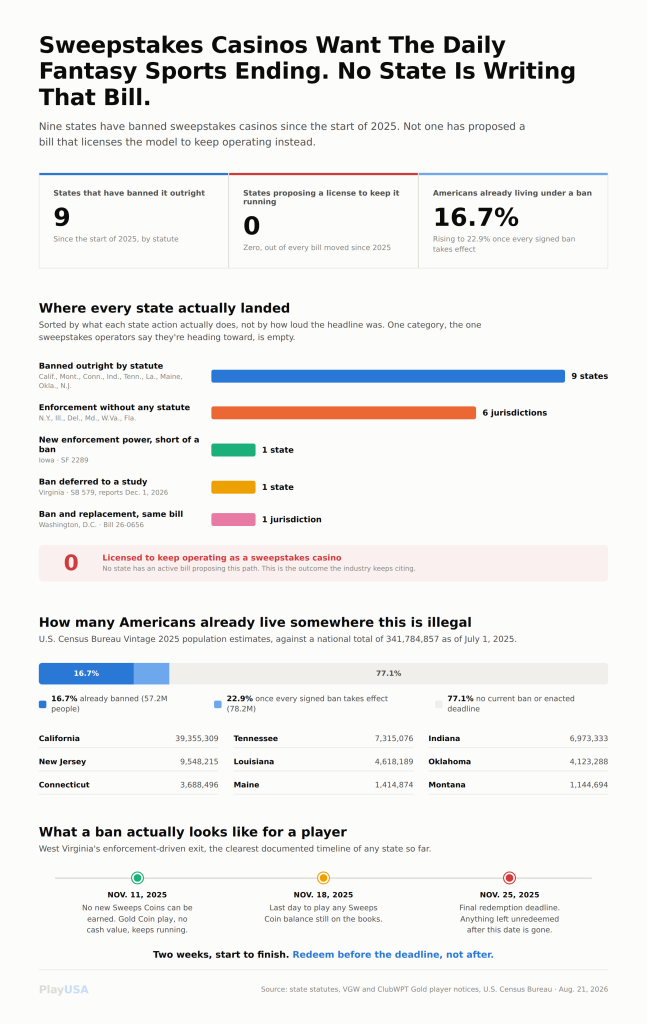
Sweepstakes casinos are heading somewhere else. Nine states have banned the model outright since last year. Zero have proposed a framework that lets a sweepstakes operator keep running as one, licensed and taxed the way a DFS site eventually was.
Shawn Fluharty runs point on this exact question for state lawmakers. He is president of the National Council of Legislators from Gaming States and the minority whip in the West Virginia House of Delegates, and he has watched attorneys general work through the DFS fight once already.
Sweepstakes operators lean on one specific legal argument to avoid a license. Fluharty doesn’t think it holds.
“At this point, the basis for sweepstakes tends to be on statutory loopholes or arguing legislative intent is silent on the issue therefore it is not ‘illegal’ in states,” Fluharty told Casino Reports in emailed comments. “Meanwhile, the games being offered tend to meet the very elements of gambling being regulated in the states.”
The trade group representing sweepstakes operators, the Social and Promotional Games Association, argues the DFS comparison should hold. Its position, laid out in trade coverage of the fight: State attorneys general educated themselves on DFS and then decided whether or not they wanted to regulate it, and sweepstakes should get the same runway.
The clearest version of that argument has a name. Jeff Cohen, head of origination at the investment firm PvX Partners, called it DFS 2.0 in comments to Sweepsy last September. His prediction wasn’t a clean win or a clean loss. It was a three-way split.
“I think sweepstakes is likely to follow a similar path as DFS 2.0,” Cohen said to the site. “Some states will outright ban it while others will regulate and create licensing regimes. Others will allow operators to remain in the grey area.”
Where every state actually landed
That is not what is actually happening in a single statehouse.
Sort every state action since 2025 by what it actually does, not by how loud the headline was, and one category is empty.
| What happened | States or jurisdiction | Vehicle and date |
| Banned outright by statute | California, Montana, Connecticut, Indiana, Tennessee, Louisiana, Maine, Oklahoma, New Jersey | AB 831 (Calif., effective Jan. 1, 2026), effective Oct. 1, 2025 (Mont.), signed June 24, 2025 (Conn.), effective July 1, 2026 (Ind.), HB 1885/SB 2136 signed May 22, 2026 (Tenn.), HB 883 and HB 53 effective Aug. 1, 2026 (La.), LD 2007 effective July 2026 (Maine), effective Nov. 1, 2026 after a veto override (Okla.), A5447, signed Aug. 15, 2025, effective immediately (N.J.) |
| New enforcement power, short of a ban | Iowa | SF 2289, signed May 19, 2026, lets the Racing and Gaming Commission issue cease-and-desist orders and seek injunctions |
| Ban and a replacement licensed product, same bill | Washington, D.C. | Bill 26-0656, introduced April 2026, would legalize online casino gaming and ban dual-currency sweepstakes at once |
| Ban deferred to a study | Virginia | SB 579, amended from a ban into a Lottery Board study due Dec. 1, 2026, with the General Assembly deciding in 2027 |
| Enforcement without any statute | New York, Illinois, Delaware, Maryland, West Virginia, Florida | Cease-and-desist letters, subpoenas, or in Florida’s case a civil lawsuit filed Aug. 19, 2026, rather than a statute |
| Licensed to keep operating as a sweepstakes casino | None |
Six ways states have moved. Five of them end in the product going away or going quiet. The sixth is a study that reports back in December.
None of them is a license.
How the industry avoids a casino license in the first place
The mechanism under all of this hasn’t changed. Sweepstakes casinos sell Gold Coins, which carry no cash value and exist so someone can play. Buying a Gold Coin package also hands over a promotional currency, Sweeps Coins, that can be redeemed for cash prizes at roughly a dollar apiece.
Because Sweeps Coins can also be requested for free with no purchase required, the operators’ position is that nothing of value changed hands to enter, so nothing about it is gambling.
Think of it as a raffle that happens to also be a casino, running on the same legal theory that lets a cereal company give away a sweepstakes entry with a box top.
Regulators keep rejecting that framing when they write cease-and-desist letters and file lawsuits. States moving to an outright ban skip the argument entirely and add the words “dual currency” to whatever their gambling statute already prohibits.
How many Americans already live somewhere this is illegal
Nine states is a number. It doesn’t tell you how much of the country that actually covers.
Add up the population of every state with a ban already in effect right now —California, Montana, Connecticut, Indiana, Louisiana, Maine and New Jersey — using the Census Bureau’s own Vintage 2025 estimates, and it comes to more than 66 million people.
Divide that against the Census Bureau’s Vintage 2025 national estimate, 341,784,857 as of July 1, 2025, and 19.5% of the country already lives somewhere this product is illegal by statute.
That number is about to get bigger. Tennessee’s ban was signed into law May 22 and took effect immediately, while Oklahoma’s ban is set to take effect Nov. 1, 2026.
Once Oklahoma’s ban takes effect, the population living in states where sweepstakes casinos are prohibited by statute will climb from 66.7 million to roughly 70.9 million people, or about 20.7% of the country.
Here’s the count, state by state:
| State | Population, Census Bureau Vintage 2025 estimate | Ban status |
| California | 39,355,309 | Effective Jan. 1, 2026 |
| Montana | 1,144,694 | Effective Oct. 1, 2025 |
| Connecticut | 3,688,496 | Effective Oct. 2025 |
| Indiana | 6,973,333 | Effective July 1, 2026 |
| Louisiana | 4,618,189 | Effective Aug. 1, 2026 |
| Maine | 1,414,874 | Effective July 2026 |
| Tennessee | 7,315,076 | Signed May 22, 2026; effective date unconfirmed |
| New Jersey | 9,548,215 | Effective Aug. 15, 2025 |
| Oklahoma | 4,123,288 | Effective Nov. 1, 2026 |
Even once Tennessee and Oklahoma take effect, more than three in four Americans are in states where nothing currently stops a sweepstakes casino from operating. The bans are real. They are also, so far, a minority position.
What happens to a player when a ban actually lands
West Virginia is the clearest example of what an enforcement-driven exit looks like from the inside, because VGW spelled out the whole timeline instead of leaving it to a press release.
Chumba Casino, LuckyLand Slots and Global Poker players in West Virginia lost the ability to earn new Sweeps Coins on Nov. 11, 2025. They had until Nov. 18 to keep playing whatever balance they had left in promotional mode. Any Sweeps Coins sitting unredeemed after Nov. 25 were gone.
Two weeks, start to finish. Gold Coin play, the free-to-play half with no cash value, kept running the whole time.
That is the actual shape of an enforcement-driven exit. Not a switch that flips. A countdown, with the free version of the game left standing after the money half is gone.
Connecticut ran a version of the same clock ahead of its own Oct. 1, 2025, effective date. ClubWPT Gold told players to expect their accounts to close by Sept. 30, one day ahead of the ban taking effect.
VGW is running a bigger version of the same countdown in 2026, shutting down the LuckyLand Slots brand entirely: Gameplay ends Aug. 24, account access closes Sept. 14, and any unredeemed Sweeps Coin balance after that is gone. That one wasn’t a state forcing the issue. VGW made the call itself, amid the same pressure, and gave players the same kind of window anyway.
ClubWPT Gold took a fourth path out of the same pressure, and it isn’t a wind-down at all. On Sept. 24, 2025, it dropped its Gold Coin system entirely and replaced it with a model built around purchasing poker hand analysis credits, which also hand out redeemable chips as a side effect.
The company says the switch helps it comply with new state laws that specifically target the dual-currency structure. The chips still redeem for cash the same way Sweeps Coins did. The purchase funnel now runs through a training tool instead of a coin package.
That is a real distinction, if a court ever rules on it.
Which hasn’t happened. Not for ClubWPT Gold’s version of the workaround, and not for anyone else’s.
Should sweepstakes casinos expect the DFS ending?
State it fairly: the comparison isn’t crazy on its face. Both categories exist because a licensed, regulated version of the same activity wasn’t legal or wasn’t available in most states when they launched. Both drew years of cease-and-desist letters and lawsuits before anything settled. Both spent heavily on advertising while the legal fight was still live.
Here’s where it breaks. With DFS, the actual proposal on the table in most fights was licensing: a state-by-state framework that let operators keep running the same product under a tax and a regulator. Nobody has put that proposal on the table for sweepstakes anywhere. Every bill that has actually moved either kills the product or swaps it for something else, a licensed online casino, in the same breath.
Kill it flat: there is no state with an active bill that licenses a sweepstakes casino to keep operating as a sweepstakes casino.
There’s a structural reason licensing keeps landing empty, too. If a state ever does write that bill, it will not invent a new “sweepstakes casino” license. It already has the license that would actually apply: a real-money online casino license, the kind any regular operator needs. Washington, D.C.’s Bill 26-0656 shows that shape directly, legalizing online casino gaming and banning dual-currency sweepstakes in the same act.
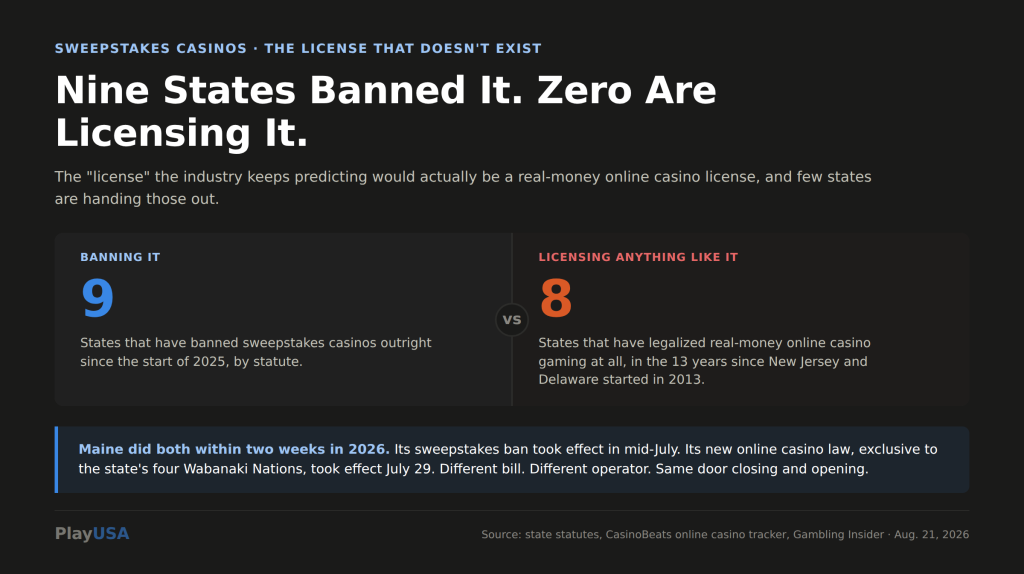
That path barely exists to begin with. Only eight states — New Jersey, Delaware, Pennsylvania, West Virginia, Michigan, Connecticut, Rhode Island and, as of this year, Maine — have legalized real-money online casino gaming at all, 13 years after New Jersey became the first.
Momentum keeps stalling rather than spreading. Michigan launched in January 2021 and no other state followed until Rhode Island in 2024.
Even where that license already exists, sweepstakes operators haven’t stepped into it. New Jersey and Connecticut both had a working online casino law on the books years before they banned sweepstakes casinos instead of folding them into it.
Delaware and West Virginia are enforcing against sweepstakes right now, with that same license sitting there, unused by that side of the business.
Maine did both within weeks of each other: its sweepstakes ban, LD 2007, takes effect in mid-July 2026, and its tribal online casino law, LD 1164, giving the state’s four Wabanaki Nations the exclusive right to run one, takes effect July 29, 2026. Separate bills, not a coordinated swap, but the shape on the ground is the same one D.C. is trying to write into a single act. The workaround closes. The license that opens next to it was never built for a sweepstakes operator to walk into.
Cohen’s DFS 2.0 forecast was a three-way split: bans in some states, licensing regimes in others, gray-area tolerance in the rest. A year on, two-thirds of it has shown up. Nine states banned the model, right on schedule.
A long list of others are enforcing against it with no statute at all, Cohen’s gray-area category playing out almost exactly as described. The licensing-regime third, the one that would actually let a sweepstakes casino keep being one, is still empty, and given how few states have any online casino license to hand out in the first place, there’s little reason to expect that to change soon.
The DFS precedent comes with a warning
Here’s what the DFS comparison actually gives back, though, and it’s not nothing. DFS didn’t get a clean, fast, uniform legalization either. Washington, Hawaii, Nevada, Idaho and Montana still ban it outright today, a decade in. Virginia only started taxing daily fantasy contests this year, according to Legal Sports Report, a full 10 years after it first legalized them.
If sweepstakes casinos really do get the DFS treatment, best case, that treatment took a decade to go from grudging tolerance to actual tax code, and it still left five states as permanent holdouts. Operators pitching the DFS ending as a reason to hang on are pitching a decade of limbo, not a rescue.
Where the states that haven’t banned it stand right now
This moves fast. Confirmed as of today.
States open, for now, with no ban and no pending bill found in this pass: most of the country. That is not a stable list and it will look different by the time this piece gets a refresh.
States enforcing without a law on the books:
- New York sent cease-and-desist letters to 26 operators in June 2025.
- Illinois sent 65 in February 2026 and, by one count, got 3% compliance.
- Delaware and Maryland have gone after VGW by name specifically.
- West Virginia issued more than 50 subpoenas and saw more than 20 platforms leave.
States that chose a lawsuit over waiting on a statute: Florida sued VGW and Stake on Aug. 19, 2026, calling the operation an unlicensed casino outright.
The one state actually studying a middle path: Virginia’s work group reports back by Dec. 1, 2026, with the General Assembly voting on what to do with it in the 2027 session. That is the one date on this list worth calendaring if a regulated version of this product is ever going to exist anywhere.
The one bill that pairs a ban with a replacement: Washington, D.C.’s Bill 26-0656 would legalize online casino gaming and outlaw dual-currency sweepstakes in the same act. It had a hearing in April 2026 and, as of mid-August, had not reached a council vote.
Part of the holdup has nothing to do with sweepstakes at all: Testimony has raised the federal Johnson Act as a possible obstacle to the online casino half, a wrinkle that doesn’t exist for a state passing the same kind of bill.
What should players do as rules change
If your state bans the model, sues your operator or your operator restructures on its own, redeem what you have before the deadline arrives, not after.
West Virginia’s two-week countdown and VGW’s LuckyLand Slots shutdown are both the model for how little warning that clock actually carries, and Florida’s lawsuit against VGW and Stake is the same pressure by another name, playing out in a courtroom instead of a statehouse.
Watch for products that change how they describe their currency without changing what a player can still redeem it for. That kind of rebrand hasn’t been tested in court, and until it is, treat it as a company betting on new language rather than a company operating under new rules. And check any specific state’s current status before relying on this list. It was accurate the day this published.