






NinjaTrader offers deep futures market exposure but a dated interface. Interactive Brokers has broader brokerage integration and a stronger security framework for serious traders.
Interactive Brokers Review

Bonus Coming Soon!
Deposit methods


- Backed by one of the world's largest brokerages.
- Event contracts integrate seamlessly with your existing IB brokerage account.
- Strong coverage of macroeconomic and political forecasting markets.
Bonus Coming Soon!
Bonus Coming Soon!
Interactive Brokers occupies a very different position in the prediction market ecosystem than most platforms people talk about today.
When people think of prediction markets, they often think of apps like Kalshi or Polymarket, where users speculate on elections, macroeconomic indicators, and cultural events. Interactive Brokers approaches the idea from a completely different direction.
Rather than building a standalone prediction platform, Interactive Brokers integrates event forecasting contracts into its existing brokerage infrastructure.
This prediction market offering is called IBKR ForecastTrader, and it sits within the same platform users already use to trade stocks, options, and futures.
Forecasting contracts allow users to trade positions on real-world outcomes such as economic data releases, elections, and policy decisions.
The structure is closer to a financial trading platform than a traditional betting product, which immediately makes the experience feel different from most consumer prediction apps.
What makes Interactive Brokers especially interesting is that it brings prediction markets into the professional trading platform environment.
Instead of opening a separate app designed primarily for entertainment or casual speculation, users interact with contracts on one of the largest electronic brokerage platforms in the world.
When I first started exploring Interactive Brokers’ forecast contracts, I wanted to understand whether this institutional environment actually improved the prediction market experience.
The idea of trading event contracts alongside stocks, options, and futures sounded interesting. Still, I also wondered whether the complexity of a professional brokerage platform would make the system difficult for average users.
For this Interactive Brokers review, I evaluated the site across the areas that matter most when analyzing prediction platforms: onboarding process, bonus structure, market coverage, liquidity, interface quality, security infrastructure, and overall usability.
I also compared the platform to other prediction apps, as well as sportsbook-style prediction products that are becoming more common in the United States.
The result is a platform that excels in infrastructure and security but also has some clear tradeoffs. Interactive Brokers offers institutional-grade reliability and liquidity, but it lacks the accessibility and entertainment-focused design that many modern prediction apps offer.
To keep things consistent, I evaluated Interactive Brokers across seven categories that matter most to prediction market users.
Ratings Snapshot
| Category | Rating |
|---|---|
| Overall Rating | 4.1 / 5 |
| Sign-Up Bonus | 2.5 / 5 |
| Market Coverage | 4.6 / 5 |
| Benefits for Existing Users | 4.3 / 5 |
| Customer Support | 4.5 / 5 |
| Security & Fairness | 5.0 / 5 |
| Website & App Experience | 3.8 / 5 |
Overall Rating: 4.1 / 5
After exploring Interactive Brokers’ forecasting contracts, my biggest takeaway is that the platform feels like a professional trading product rather than a consumer prediction market. That distinction is extremely important.
Most prediction apps are designed to be simple and engaging. They want users to browse markets quickly, place trades with a few taps, and interact with the platform in a way that feels closer to social media than financial trading. Interactive Brokers does the opposite.
The platform assumes users are already comfortable with trading infrastructure. Forecast contracts appear inside the same environment used to trade stocks, options, futures, and currencies.
The interface prioritizes data, order execution, and portfolio management rather than entertainment.
For serious traders, this environment is incredibly powerful. Having prediction-style contracts alongside traditional financial instruments opens the door to new hedging strategies and economic positioning.
However, the same features that make the platform powerful also make it so much less approachable for casual users.
Interactive Brokers excels in reliability, transparency, and institutional-grade execution. But compared to consumer-focused prediction apps, it can feel intimidating and outdated from a design perspective.
Despite those limitations, the platform still performs above average in the prediction market space due to its robust infrastructure and credibility.
Sign-Up Bonus: 2.5 / 5
If you are coming to Interactive Brokers expecting the type of welcome promotions common in prediction apps or sportsbooks, you will be disappointed.
Interactive Brokers does not operate with aggressive sign-up bonuses. In fact, the platform offers little to no promotional incentives for new users who want to trade forecasting contracts.
This is a sharp contrast to many consumer prediction platforms. Kalshi frequently offers trading credits or promotional rebates for new users. Underdog Predict sometimes advertises deposit matches worth hundreds of dollars.
Sportsbooks regularly offer risk-free bets or bonus bets valued between $200 and $1,000, depending on the promotion.
Interactive Brokers doesn’t compete in this category. Instead, the platform relies on its reputation as a professional brokerage and its competitive trading infrastructure to attract users.
From a pure promotional standpoint, that makes Interactive Brokers one of the weakest options in the industry. However, there is a reason for this. Interactive Brokers targets active traders rather than casual users.
Its value proposition revolves around financial trading and market access rather than short-term promotional incentives.
Still, I believe the platform could benefit from introducing an onboarding incentive for forecast contract traders, even if it were modest, such as fee discounts or small trading credits.
For a platform to offer prediction market trading with no sign-up bonuses, it comes across as outdated and non-incentivizing. I don’t expect to see any sign-up bonuses coming in soon, but the platform makes up for it with how the different categories interact.
Market Coverage: 4.6 / 5
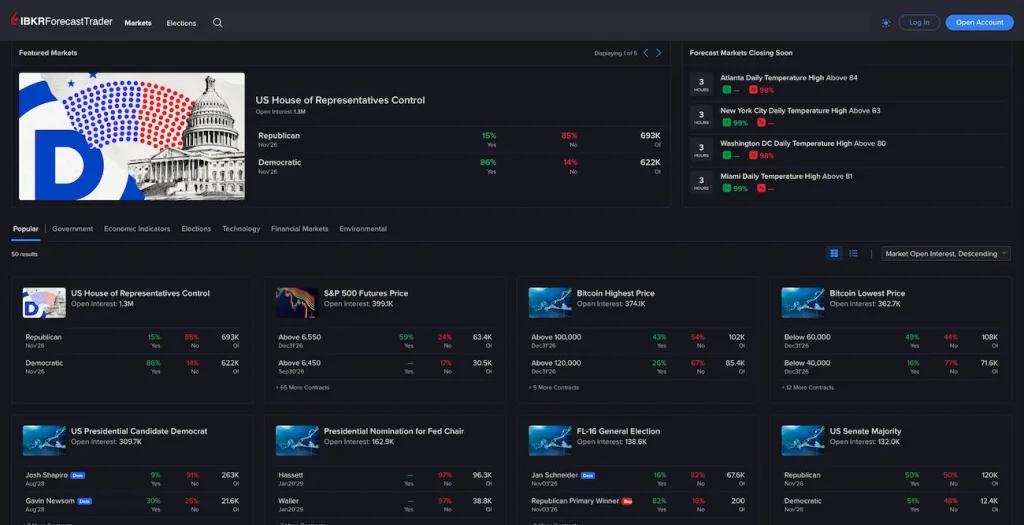
Market coverage is where Interactive Brokers begins to show its strength.
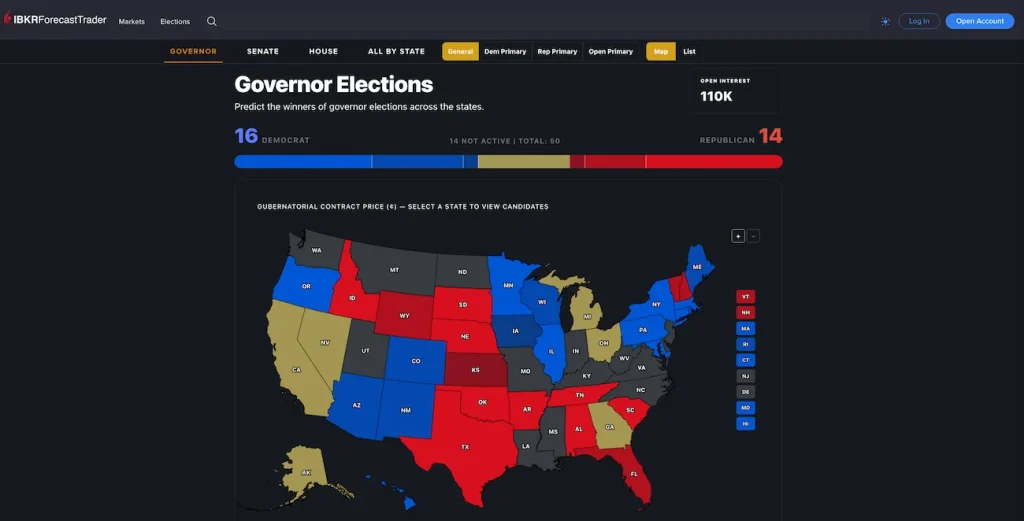
Unlike sports-focused exchanges or crypto-native prediction platforms, Interactive Brokers focuses on macroeconomic and policy-related forecasting events.
Markets often revolve around outcomes such as:
- Federal Reserve interest rate decisions
- Inflation reports
- Economic data releases
- Election results
- Political control of legislative bodies
- Policy outcomes
This focus aligns with the broader audience that Interactive Brokers typically serves: investors and traders who are already engaged with macroeconomic trends. From a forecasting perspective, these types of markets make a lot of sense.
Economic data and political outcomes directly influence financial markets. Being able to take positions on these outcomes within the same brokerage account used for traditional trading creates interesting opportunities.
For example, a trader who expects inflation data to come in higher than expected might simultaneously adjust positions in interest rate futures, currency markets, and prediction-style contracts.
Few consumer prediction platforms offer that level of integration with financial markets.
Comparing Interactive Brokers to other prediction apps
Kalshi offers a similar range of economic and political contracts but within a standalone platform.
Polymarket provides broader cultural and global event coverage but relies heavily on crypto infrastructure.
Interactive Brokers stands out by embedding forecasting markets directly within a professional trading environment. This type of platform is a great idea with major potential, but it does come with some drawbacks, such as the lack of sign-up bonuses.
The markets are highly detailed and niche, but that level of focus can be a positive for professional traders.
I can see this concept becoming a serious powerhouse in the future as prediction market traders take trading on personal finances more seriously and want to combine the different categories of trading.
Interactive Brokers vs Polymarket
Polymarket offers broader global event markets but relies on crypto wallets and decentralized infrastructure. Interactive Brokers has no crypto integration.
Interactive Brokers vs Sporttrade
Sporttrade is a sports-focused exchange with user-driven pricing and no house margin. Interactive Brokers covers macroeconomic and political contracts within a full brokerage environment.
Benefits for Existing Users: 4.3 / 5
This is one category where Interactive Brokers performs extremely well.
Because forecast contracts are integrated directly into the brokerage platform, existing Interactive Brokers users gain immediate access without needing to open a separate account or transfer funds. For active traders who already use the platform to manage investments, this integration is incredibly convenient.
Users can trade event contracts using the same account, funding methods, and interface they already use for other financial investments. This unified environment makes the prediction markets feel like a natural extension of the trading platform rather than a separate product.
The website separates the prediction functionality into a page called IBKR ForecastTrader, while the app has everything in one place. Compared to standalone prediction apps, this level of integration is a major advantage.
Customer Support: 4.5 / 5
Interactive Brokers has a long history of supporting active traders, and its customer support infrastructure reflects that.
The platform offers several support channels, including:
- Help center documentation
- Ticket-based support
- Phone support
- Live chat in certain regions
In my experience, the knowledge base is extensive. Because the platform supports so many financial products, the documentation is detailed and well-organized.
Response times are generally reliable, though the platform’s complexity and size sometimes mean answers can take longer than on smaller apps.
Overall, the support experience feels professional and consistent with what you would expect from a major brokerage firm.
Security and Fairness: 5.0 / 5
Security is where Interactive Brokers clearly separates itself from most prediction platforms. The company operates one of the largest brokerage infrastructures in the world and is regulated across multiple jurisdictions.
Accounts are protected through strict compliance systems, encryption protocols, and identity verification procedures.
Key security features include:
- Two-factor authentication
- Biometric login options
- Advanced encryption
- Fraud monitoring systems
- Regulated clearing infrastructure
Because the platform operates as a brokerage rather than a casual betting/trading app, its security framework feels extremely robust. From a market integrity perspective, Interactive Brokers also benefits from transparent contract rules and regulated settlement processes.
Compared with decentralized prediction platforms that rely on crypto wallets and smart contracts, the infrastructure here feels far more institutional.
Website & App Experience: 3.8 / 5
The Interactive Brokers interface is powerful, but it’s not friendly to beginners.
The platform’s Trader Workstation and mobile apps are designed primarily for professional traders. As a result, the layout prioritizes data density rather than simplicity.
Forecast contracts appear alongside other trading instruments, which can initially make the interface feel cluttered and overwhelming if you are unfamiliar with the system.
Once I got more comfortable navigating the platform, however, the depth of information available became a major advantage. Users can analyze markets, track positions, and manage risk with far greater precision than most consumer prediction apps allow.
Still, from a usability standpoint, the interface is not as intuitive as modern prediction platforms built specifically for event trading. The interface isn’t overly cluttered, but it has some clarity issues for beginners.
Banking & Payments
Interactive Brokers offers a wide range of funding options typical of brokerage accounts.
Users can deposit funds using:
- Bank transfers
- Wire transfers
- ACH transfers
- International transfers
- Mail-in checks
Withdrawals typically process within a few business days, depending on the method used.
Because the platform operates in traditional financial markets, all transactions occur in fiat currency rather than crypto tokens.
Regulation & Legal Considerations
Interactive Brokers operates under strict financial regulatory frameworks in multiple jurisdictions. Users must complete full identity verification before accessing trading features.
Compliance procedures include KYC verification, anti-money laundering checks, and account monitoring systems. I found the account creation process to be infuriating compared to other prediction market platforms, but that’s to be expected with a professional trading platform rather than an exchange like Kalshi or Polymarket.
Forecast contracts are structured to comply with regulatory requirements governing financial derivatives. This regulatory clarity gives the platform an advantage over prediction apps operating in uncertain legal environments.
Pros & Cons
Interactive Brokers is built for serious traders, not casual bettors. That focus shapes everything, from its institutional security standards to its no-frills approach to promotions. Here’s a quick breakdown of where the platform excels and where it falls short.
Pros
- Institutional-grade infrastructure
- High security standards
- Integration with brokerage trading tools
- Strong macroeconomic event coverage
- Reliable regulatory framework
Cons
- Very limited promotions
- Steep learning curve
- Interface can feel outdated
- Not designed for casual prediction users
- Limited categories
Who Should Use Interactive Brokers
Interactive Brokers isn’t for everyone, and it doesn’t try to be. The platform is best suited to users who are already comfortable with financial trading and want to incorporate event contracts into a broader investment strategy.
Best for
- Professional traders
- Macro-focused investors
- Users already on the IB platform
Not ideal for
- Casual prediction market users
- People seeking entertainment-style betting apps
- Users who prioritize sign-up bonuses
Latest Updates on Interactive Brokers
Stay up to date with the latest platform enhancements, financial milestones, and market expansions from Interactive Brokers. This list has been updated as of Sep. 1, 2026.
| Date | Update |
|---|---|
| Aug. 27, 2026 | Interactive Brokers remains one of only two approved Canadian providers of event-contract trading — The guidance of Canadian regulators confirmed that Interactive Brokers is one of the two firms authorized to offer prediction market contracts to Canadian clients, alongside Wealthsimple. Its permitted Canadian offering remains limited to contracts tied to economic indicators, financial markets and climate outcomes; sports and entertainment contracts are not permitted under the applicable securities-and-derivatives framework. |
| Jul. 22, 2026 | Interactive Brokers founder discusses prediction market offerings and AI-sector concerns — Interactive Brokers Chairman and Founder Thomas Peterffy appeared on CNBC’s Squawk on the Street following the company’s second-quarter earnings. He discussed customer caution toward the AI sector, market volatility, Interactive Brokers’ growth strategy, and the company’s prediction-market offerings. |
Long-Term Outlook
Prediction markets are slowly moving closer to traditional financial infrastructure. Interactive Brokers may represent a glimpse of what that future could look like.
If forecasting contracts continue to expand on brokerage platforms, prediction markets could become more integrated with mainstream financial trading and really demonstrate the possibilities of prediction markets in traditional financial settings.
FAQ
New to Interactive Brokers’ prediction markets? Here are answers to the most common questions about the platform’s forecast contracts and how they work.
IBKR ForecastTrader is Interactive Brokers’ dedicated prediction market experience. It lets users trade yes-or-no contracts on real-world outcomes, including economic indicators, elections, and climate events, using their existing IB account. It can be accessed through the web, mobile app, Trader Workstation, and other IB platforms.
No. Forecast contracts on ForecastEx are commission-free. The exchange only executes trades when the Yes and No sides add up to $1.01, with both sides covering a small portion of that penny as the exchange fee.
Markets cover a wide range of economic and political outcomes, including Fed rate decisions, inflation reports, unemployment data, election results, energy prices, and even climate indicators like atmospheric CO2 and temperature. CME event contracts on futures markets are also available.
No. Existing Interactive Brokers clients can access forecast contracts directly through their current account. Trading permissions are usually approved immediately after requesting them.
You must be at least 21 years old and an eligible client of Interactive Brokers to trade forecast contracts.
Yes. Forecast contracts pay an interest-like incentive coupon that accrues daily and is paid monthly, currently at a rate of 3.14% APY on the closing market value of open positions.
Final Verdict
After reviewing Interactive Brokers’ prediction contracts, I see the platform as one of the most credible institutional players in the prediction market space.
It lacks the flashy design and promotional incentives found in consumer prediction apps, but it compensates with infrastructure, security, and professional trading tools.
For serious traders who already use Interactive Brokers, the forecasting contracts add a valuable new dimension to the platform. For casual users, however, the experience may feel overly complex, but it can open new doors to incorporate prediction markets into their financial toolset.
Interactive Brokers earns a 4.1 out of 5 rating by delivering a strong institutional-grade prediction market experience while leaving plenty of room for improvement in accessibility and promotions.
I can see this platform becoming something users have never seen before, with serious potential to shift the nature of prediction markets and what they can offer.

